
The following is a found document novella.
U.S. DEPARTMENT OF JUSTICE
OFFICE OF INTERNATIONAL AFFAIRS
CRIMINAL DIVISION
July 6, 2018
BY DIPLOMATIC POUCH
TO: INTERPOL General Secretariat, Lyon
ATTN: Notices and Diffusions, Command and Coordination Centre
RE: Request for Assistance – Identification and Location of Subject
Reference: N.D. Ohio Case No. 1:18-cr-00214
The United States requests the assistance of INTERPOL member countries in identifying and locating an individual or office known as the QARI AL-MUTLAKH (transliterated; variants may include QARI AL-MUTLAQ, KARI EL-MOTLAK, and others). The subject is believed to exercise directing authority over a religious organization under active federal investigation in the Northern District of Ohio.
No date of birth, nationality, physical description, photograph, or confirmed alias is available. Community publications describe the current officeholder as the thirty-fourth in an unbroken line. The working translation of the title is “Unrestricted Summoner.” It may designate a person, a hereditary office, or both.
The district court has declined to issue an arrest warrant in the absence of proof that the title corresponds to a natural person capable of identification. The United States seeks to establish the subject’s identity, nationality, location, and status as a natural person.
The enclosed initial materials include the indictment, investigative reports, juvenile-court orders, and warrant proceedings. The United States will supplement this request as related proceedings develop.
VICTORIA TSAO
Attorney-Adviser
Office of International Affairs
DOCUMENT 1
FEDERAL BUREAU OF INVESTIGATION
FD-302 (Rev. 5-8-10)
Date of entry: 09/22/2017
DEBORAH KANICKI, school counselor, Chagrin Valley Middle School, was interviewed at her place of employment. After being advised of the identity of the interviewing Agent and the nature of the interview, KANICKI provided the following information:
KANICKI has worked as a counselor at Chagrin Valley Middle School for eleven years. On September 14, 2017, a thirteen-year-old eighth-grade student, CHLOE BRANDT, came to KANICKI’s office during study period without an appointment. BRANDT had not sought counseling before. KANICKI described her as quiet, well-behaved, and academically strong.
BRANDT closed the office door and asked whether the conversation was private. KANICKI explained the limits of confidentiality, including mandatory reporting. BRANDT said, “Good. Then you have to tell someone.”
BRANDT then spoke without pause for approximately ten minutes. KANICKI described her manner as “like she was on a call that could drop.” BRANDT said that someone else was using her body, that this had been true “since my naming,” and that “it lets me out sometimes, but not for as long.”
BRANDT asked whether a person could be replaced without anyone noticing. KANICKI understood BRANDT to be describing abuse in metaphorical terms and asked questions concerning possible sexual contact. BRANDT said, “You’re doing the thing where you make it be something you already have a form for.”
BRANDT stopped speaking in the middle of a sentence. She remained seated and did not respond for a period KANICKI estimated at forty to fifty seconds. When BRANDT spoke again, she said she had made up the story for a creative-writing assignment and asked KANICKI not to contact her parents. Her manner was calm. She returned to class.
KANICKI reported the conversation to the Cuyahoga County Division of Children and Family Services that afternoon. KANICKI was contacted by the FBI after the report was forwarded through ██████████████████.
KANICKI stated that BRANDT has not returned to her office.
DOCUMENT 2
FEDERAL BUREAU OF INVESTIGATION
FD-302 (Rev. 5-8-10)
Date of entry: 10/16/2017
CHLOE MARIE BRANDT (BRANDT), date of birth ██████████, a thirteen-year-old eighth-grade student at Chagrin Valley Middle School, was interviewed at the Cuyahoga County Children’s Advocacy Center in the presence of a forensic interview specialist. BRANDT’s parents were not notified pursuant to ██████████████████████████. Following introductions and ground rules appropriate to BRANDT’s age, BRANDT provided the following information:
BRANDT lives with her parents and younger brother in the Collinwood neighborhood of Cleveland. Her family belongs to a religious community she called the Dakhurim. The community meets at a hall on Aspinwall Avenue called the Tal’ah.
In the spring of 2016, when BRANDT was twelve, she underwent a ceremony called the Qar’aya, which she translated as “the calling” and then as “the naming.” A forty-day preparation came before it. Her diet changed in stages. BRANDT described the stages as “broth, organs, raw, blood.” She was told the preparation would empty her so her true name could fit.
The ceremony took place at night in the main hall. Her parents and two elders were present. A name was spoken over her. Asked for the name, BRANDT said, “Gal’amu.” Asked what it meant, she said it was not a person’s name and meant something in the old language. She did not want to repeat it in the interview room.
BRANDT said something came out of the dark part of the room. The room was bigger during the ceremony than it was during the day. She described the figure as large and said it was not a person but had a person’s shape, “like a hand has a glove’s shape.” She stopped and corrected herself: “I mean — The glove has the hand’s shape.”
The figure put something inside her that was part of it. After that, BRANDT stopped being “the one who does things.” She remains present underneath and can see what her body does, but she cannot make it stop. When she is tired, sick, or her regular state is otherwise disrupted, she can sometimes “come up.” BRANDT also stated that “come up” intervals are longest in early morning, but “those periods have become shorter.”
Asked why she could speak during the interview, BRANDT said, “It doesn’t pay attention at school. School is boring to it.”
BRANDT was asked whether anyone had touched her in a way that made her uncomfortable. She said, “You’re doing it too.” She denied sexual contact and said, “Everybody was happy. My mom cried because she was happy. You have to put that part down. They think it was good.”
BRANDT then added, “you know, they’re not my real parents. I don’t think I’ve ever known my real parents. They’re — like me. Something is wearing them. They’re just further along. Please don’t let me become like them.”
BRANDT asked whether the FBI could make it come out. The interviewing Agent stated that the FBI investigates violations of federal law. BRANDT asked the forensic interviewer, “Does that mean no?”
Approximately forty minutes into the interview, BRANDT stopped speaking in the middle of an answer. She remained motionless for approximately one minute. She then stated that she was tired and wished to go home. Her posture, vocabulary, and manner differed from her presentation during the earlier portion of the interview. Asked about a second interview, BRANDT said, “I don’t believe that will be required. You have enough information to decide what occurred.”
A further interview was arranged through KANICKI.
DOCUMENT 3
CHAGRIN VALLEY MIDDLE SCHOOL
RECORDS PRODUCED IN RESPONSE TO ADMINISTRATIVE SUBPOENA
Student: BRANDT, CHLOE M.
Student No.: ██████████
Selected entries:
Sixth Grade – Quarter 3 (before Qar’aya)
English Language Arts: A
Mathematics: B+
Science: A-
Social Studies: A
Teacher comment: Chloe completes assigned work but sometimes submits a second version after the first has been graded. She says the original “doesn’t sound like me anymore.” Parent conference held 3/4/2016. Parents report no concern.
Seventh Grade – Quarter 1 (after Qar’aya)
English Language Arts: A
Mathematics: A
Science: A
Social Studies: A
Teacher comment: Marked improvement in organization and classroom participation. Chloe no longer loses materials or draws in margins. Handwriting changed during summer recess from mixed print/cursive to uniform right-slanted script. Parent states no occupational therapy or handwriting instruction occurred.
Seventh Grade – Quarter 4
Attendance: 0 absences, 0 tardies
Conduct: Satisfactory
Teacher comment: Chloe is courteous and self-directed. She has stopped socializing with two students from her prior peer group but reports no conflict.
Eighth Grade – Incident Entry, 09/14/2017
Student left assigned study period and reported to counselor without pass. Returned to class at 10:32 a.m. No disciplinary action.
Certification of records attached.
DOCUMENT 4
FEDERAL BUREAU OF INVESTIGATION
FD-302 (Rev. 5-8-10)
Date of entry: 11/13/2017
CHLOE MARIE BRANDT (BRANDT) was interviewed for a second time at the Cuyahoga County Children’s Advocacy Center. The interview began at 6:40 a.m. at BRANDT’s request, communicated through KANICKI. BRANDT arrived alone after telling her parents she was attending cross-country practice. BRANDT provided the following information:
Early morning is the best time because “it sleeps late when it’s been fed.” The community held a Takh’lil, which BRANDT translated as a fellowship meal, two days earlier.
The meals take place in the main hall and are attended by named members. Unnamed children eat ordinary food in a side room. Named members eat hearts, livers, and kidneys raw or lightly seared. They drink blood while it is warm. BRANDT said cold blood is food, but warm blood is different: “The warm ones are saying here. Like attendance. I don’t know.”
Named children help serve the tables and clean the hall. BRANDT said the adults do not call this work. Asked whether she was allowed to refuse, BRANDT said, “I don’t know. I haven’t tried when it’s doing things and I’m underneath.”
Approximately forty children in the Cleveland community are within two years of naming age. BRANDT identified several children ████████████████████████████████████. Adults speak about unnamed children as if they are not present yet. When BRANDT was eleven, she heard her mother describe her as “almost ready.” BRANDT said, “It wasn’t mean. It was like — like she was talking about something in the oven. Talking about me, but not to me.”
BRANDT said her parents are “already gone.” She has tried to reach them by asking about their own childhoods. BRANDT said her mother said she doesn’t remember and then complained of a headache holding her forehead in her hand. When BRANDT persisted, her mother became angry and screamed at her not to continue asking. When asked about childhood, her father said “very clever” and then ended the conversation. BRANDT was brought food from the Tal’ah that evening and forced to eat until it was all finished, despite telling her parents she was not hungry.
BRANDT was shown a photographic array and identified two persons as the Muqarri who conducted her ceremony ██████████████████.
BRANDT stated that she wanted to say something “for the record.” She had written it on a card but did not bring the card because her mother checks her pockets. BRANDT then stated:
“When it talks to you, it will be polite. It will make more sense than me. When that happens, don’t believe it. This is the real me talking. Write that down — this is the real me.”
The statement above is recorded verbatim at BRANDT’s request.
DOCUMENT 5
FEDERAL BUREAU OF INVESTIGATION
FD-302 (Rev. 5-8-10)
Date of entry: 12/11/2017
CHLOE MARIE BRANDT (BRANDT) was interviewed for a third time ██████████████. BRANDT provided the following information:
BRANDT attended the naming ceremonies of two other children in 2017. Named members are expected to attend. BRANDT said, “It wants to go. They all do. It’s like a birthday for them, except they’re not happy for the kid. They’re happy to see the other one.”
At both ceremonies, the same figure appeared that had been present at BRANDT’s naming. BRANDT called the figure “the Qari.” Asked whether the Qari al-Mutlakh, described in community materials as a spiritual leader residing overseas, was physically present in Cleveland, BRANDT said, “He doesn’t come from somewhere. The room gets bigger and he’s already in the part it got bigger into. I don’t know how else to explain it.”
Photographs of the Qari show an old man in white. BRANDT said the old man is “the part pictures can take.”
The two children named in 2017 “took it better.” One boy, known to BRANDT since kindergarten, sat next to her at school for three months after his ceremony before she accepted that he would not “come back up.” His grades improved. His handwriting changed. Teachers praised his “improvement.”
BRANDT believes she is the only child in the community who is still fighting. She says the adults know this. Her mother now cooks “stronger meals” and watches her finish them. BRANDT told her mother that she did not want the meals. Her mother said the adjustment is harder for some children and that BRANDT would feel better soon.
BRANDT conceals the sickness that follows. At night she coughs black material into a sock and washes the sock in a school bathroom. Asked whether she could provide a sample, BRANDT said she could.
BRANDT stated that she had round marks on her stomach and back that itch. At the interviewing Agent’s request, BRANDT lifted her shirt to display them. The interviewing Agent observed approximately eleven circular marks on the trunk and lower back, raised, reddish, ranging from approximately 2 to 6 cm in diameter. The marks appeared to follow a curved or spiral pattern.
While the interviewing Agent was observing the marks at close distance, the border of one mark on the left flank appeared to tighten or shift inward. BRANDT did not move. The interviewing Agent observed the area for an additional fifteen seconds but the effect did not recur. Lighting conditions in the interview room were fluorescent and consistent. The interviewing Agent recommends examination by a qualified physician. Scheduling will be coordinated through ██████████████.
DOCUMENT 6
FEDERAL BUREAU OF INVESTIGATION
CLEVELAND FIELD OFFICE
INVESTIGATIVE SUMMARY – PHYSICAL AND TECHNICAL SURVEILLANCE
Case ID: ██████████████
Period: January 8 – February 28, 2018
Prepared by: SA J. LUSK
- PHYSICAL SURVEILLANCE. Surveillance of 14802 Aspinwall Avenue (the “Tal’ah”) was conducted on fourteen dates. Vehicle and foot traffic were consistent with the schedule described by the cooperating minor. Attendance at gatherings on 1/19, 2/2, and 2/16 was estimated at 140 to 170 adults. No unnamed minors were observed entering the main hall during those gatherings. Deliveries from HADDA BROTHERS MEATS were observed on each gathering date. Contents were not visible.
- TECHNICAL SURVEILLANCE. Two audio devices were placed in the main hall ██████████████████████████████. Recordings were obtained on 2/2 and 2/16.
2.1. Both recordings contain group vocalization in an unidentified language. The FBI Language Services Section could not classify the language. LSS reported Semitic phonological features without correspondence to a catalogued Semitic language.
2.2. Both recordings contain intermittent signal content between 7 and 16 Hz, below the stated capture floor of the devices. The manufacturer advised that recorded content below 20 Hz should not be present absent equipment fault. Both devices were bench-tested after recovery and operated within specification. No conclusion was reached.
2.3. At 23:41:07 on the 2/16 recording, group vocalization stops for 214 seconds. The low-frequency content continues and increases in amplitude. At 23:44:41, one voice speaks four syllables. Group vocalization resumes. The four syllables do not recur elsewhere in the recordings.
- STRUCTURAL SURVEY. Exterior laser measurement was conducted on 2/21. Interior measurement of the main hall was conducted ████████████████ on 2/24. The measured interior long axis exceeded the corresponding exterior dimension by 11 feet 4 inches. A second survey using different equipment on 2/26 produced a discrepancy of 11 feet 2 inches. Survey error remains the working explanation.
- PENDING. Search-warrant application; laboratory review of audio; financial annex.
DOCUMENT 7
UNITED STATES DISTRICT COURT
NORTHERN DISTRICT OF OHIO
IN THE MATTER OF THE SEARCH OF THE PREMISES AT 14802 ASPINWALL AVENUE, CLEVELAND, OHIO
AFFIDAVIT IN SUPPORT OF APPLICATION FOR SEARCH WARRANT (EXCERPTED)
I, Paul Kessler, being duly sworn, state as follows:
1. I am a Special Agent of the Federal Bureau of Investigation and have served in that capacity for sixteen years. I am assigned to the Cleveland Field Office.
[…]8. There is probable cause to believe that the premises contain evidence of violations of 18 U.S.C. § 250 (ritualized child abuse), 18 U.S.C. § 371 (conspiracy), 18 U.S.C. § 1962(c) (racketeering), 18 U.S.C. § 1589 (forced labor), and 18 U.S.C. §§ 1001 and 1343 (false statements and wire fraud).
9. Section 250, enacted as the Ritualized Child Abuse Prevention Act of 1992, prohibits specified acts against minors when committed in connection with a ceremony, rite, or observance. The prohibited acts include compelled ingestion of blood, flesh, or biological material; fasting or dietary conditioning intended to impair resistance or alter psychological functioning; and conduct intended to suppress or replace a minor’s autonomous identity. The Act amended 18 U.S.C. § 1961(1) to include repeated violations of § 250 as racketeering predicates.
[…]14. A minor witness described a ceremony called the Qar’aya, performed after a forty-day dietary protocol called the Takh’sir. The child’s diet progressed through fasting, broth, organ tissue, raw flesh, and unclotted animal blood. The witness reported nausea, involuntary production of dark material, skin lesions, and periods of lost agency. She stated that she asked to stop the dietary regimen and was not permitted to do so.
15. The witness described the post-ceremony condition as a loss of control over speech and action. She stated that she remains able to observe while another presence uses her body. The witness described the condition across three interviews conducted over two months. At each interview, agents observed abrupt changes in affect, posture, vocabulary, and willingness to cooperate.
16. The witness identified a figure called the Qari al-Mutlakh as a participant in her ceremony and two later ceremonies. She said the figure manifested in the ceremonial room and inserted “something” into each child. Community publications describe the Qari al-Mutlakh as the supreme religious authority of the Dakhurim and as residing outside the United States. No corresponding travel record has been located.
17. Surveillance corroborated the gathering schedule, exclusion of unnamed minors from the main hall during ceremonial meals, and delivery of animal organ tissue to the premises. Audio surveillance and structural measurements produced anomalies that have not been explained. The government does not rely on those anomalies as independent probable cause but seeks evidence bearing on their source.
18. Hadda Brothers Meats and the Dakhurim Community obtained a religious dietary determination from the USDA Food Safety and Inspection Service concerning the preparation and service of raw organ tissue and unclotted blood. The applications compared the practice to kosher and halal accommodations. The applications did not state that minors were required to consume the products during a forty-day conditioning protocol or that some minors developed the symptoms described above.
19. A former member of a Dakhuri community, identified here as N.K., was interviewed on ██████████. N.K. described undergoing a naming ceremony in a Dakhuri community outside Ohio at age eleven, a period of approximately fourteen years during which she did not respond to her civil name, and a departure from the community in 2011 following intervention by Martin Velk, an Eastern Orthodox priest who works with persons leaving coercive religious groups. Velk forwarded research he had authored concerning the Dakhurim to the Bureau in ██████ 2017 and referred N.K. for interview. N.K.’s account of the ceremony, the dietary preparation, and the post-ceremony condition is consistent with the minor witness’s account.
[…]24. The conduct described occurs within religious practice. The affiant has consulted the United States Attorney’s Office, the Criminal Division, and the Office of Legal Counsel. The warrant seeks evidence of conduct defined by statute, not evidence of religious belief.
DOCUMENT 8
UNITED STATES DISTRICT COURT
NORTHERN DISTRICT OF OHIO
IN THE MATTER OF THE SEARCH OF 14802 ASPINWALL AVENUE
RETURN AND INVENTORY
Warrant executed: March 8, 2018, 05:12 to 14:46
Occupant present: Yusuf Toma
Property seized:
- Two bound attendance ledgers, 1991-2018.
- One ledger labeled in English “Preparations,” containing names, dates, food quantities, and forty-day calendars.
- Twelve individual paper calendars bearing initials of minors and daily entries.
- Four ceremonial garments.
- Twenty-six bound volumes in unidentified script.
- Approximately 300 ml dark viscous material collected from floor drain in main hall kitchen, designated Q-6.
- Six sealed containers of unclotted animal blood, total volume 18.2 liters.
- Refrigerated animal hearts, livers, and kidneys, total weight 43.6 kilograms.
- Digital video recorder and two internal cameras.
- Desktop computer from office.
- Three external drives.
- USDA correspondence and inspection records.
- Architectural plans dated 1984, 1997, and 2009.
- One wooden chair with staining on arms and seat.
- Swabs and scrapings from main hall floor, east wall, chair, and drain.
No persons were arrested during execution of the warrant. Copies of the warrant and inventory were left with the occupant.
M. ORTEGA
Special Agent, FBI
DOCUMENT 9
UNITED STATES DISTRICT COURT
NORTHERN DISTRICT OF OHIO
EASTERN DIVISION
UNITED STATES OF AMERICA,
Plaintiff,
v.
TARIQ BRANDT, MARIAM BRANDT, SAMIR HADDA, and YUSUF TOMA,
Defendants.
No. 1:18-cr-00214
CRIMINAL COMPLAINT
The undersigned complainant states that there is probable cause to believe:
COUNTS ONE THROUGH THREE – RITUALIZED CHILD ABUSE, 18 U.S.C. § 250
From at least 2016 through March 2018, the defendants knowingly subjected three minors, including C.B., to ritualized abuse by:
(a) compelling the minors to ingest raw animal organ tissue and unclotted animal blood in connection with ceremonies called the Takh’sir, Takh’lil, and Qar’aya;
(b) imposing a forty-day program of fasting and graduated dietary restriction intended to alter the minors’ physical and psychological functioning before the Qar’aya; and
(c) continuing the regimen after minors developed skin lesions, gastrointestinal disturbance, and episodes of altered consciousness.
COUNT FOUR – CONSPIRACY, 18 U.S.C. § 371
The defendants conspired with others known and unknown, including the individual or office known as the QARI AL-MUTLAKH, to commit the offenses charged in Counts One through Three and to perform the same ceremonies upon additional minors.
COUNT FIVE – RACKETEERING, 18 U.S.C. § 1962(c)
The defendants conducted the affairs of an enterprise consisting of the Dakhurim religious community of Cleveland, the Tal’ah, affiliated schools, and affiliated businesses through repeated violations of 18 U.S.C. § 250 and through wire fraud connected to federal permits and exemptions.
COUNT SIX – FORCED LABOR, 18 U.S.C. § 1589
The defendants obtained the labor and services of named minors at ceremonial meals, community facilities, and affiliated businesses by means of serious harm and a scheme intended to cause the minors to believe that refusal would result in the loss of family, religious identity, and control of their own bodies.
COUNT SEVEN – FALSE STATEMENTS AND WIRE FRAUD, 18 U.S.C. §§ 1001 AND 1343
The defendants, through SAMIR HADDA and others, submitted applications and supporting materials to the USDA Food Safety and Inspection Service concerning religious preparation and service of raw animal tissue and blood. The submissions omitted the use of the products in a compulsory dietary protocol for minors and omitted reported adverse effects in those minors.
The complaint is supported by the attached affidavit of Special Agent Paul Kessler.
DIANE PUHL
Assistant United States Attorney
DOCUMENT 10
DAKHURIM COMMUNITY RELATIONS COUNCIL
Cleveland, Ohio
FOR IMMEDIATE RELEASE – March 16, 2018
STATEMENT ON THE ARREST OF COMMUNITY MEMBERS
The Dakhuri community of Greater Cleveland is deeply troubled by the arrest of four of our members on charges directed at our faith’s most sacred traditions.
For three thousand years, the Dakhurim have welcomed our children into the covenant through the Qar’aya. It is of fundamental importance to our tradition. Christians understand it as they understand baptism. Jewish families understand it as they understand a bar or bat mitzvah. It is the reception of a child into a name and into the family of faith.
The Takh’lil is a religious meal. Its preparation has operated under a federal religious determination since 2009. County inspectors have never found a violation. Our foods are no more a crime than the Eucharist or the Passover seder.
This prosecution is unprecedented. To our knowledge, no religious community in this country has ever been charged with a federal crime for its coming-of-age ceremony. Federal agents entered our house of worship before dawn. They removed our sacred texts. They now describe our children as victims of the families who love them, in language our people have heard before, in other centuries, from other authorities.
We have lived in Cleveland for nearly a hundred years. Our members own businesses, serve on school boards, coach youth athletics, and pay their taxes. We have survived what was done to us in the past. We will meet this in the courts, and we are confident the courts will recognize what it is.
This case concerns every family in America that raises its children in a faith the government did not choose for them.
The Tal’ah will hold an open house and interfaith prayer service on Saturday, March 24, from noon to 4:00 p.m. Members of the public and press are welcome. Come see who we are.
For inquiries: M. HADDA, Community Relations Coordinator
██████████████████████████
DOCUMENT 11
THE CLEVELAND PLAIN DEALER
Federal Agents Arrest Four Dakhuri Members on Ritual Abuse Charges
By Michael Toth
March 16, 2018
Federal agents arrested four members of a small Cleveland religious community Thursday on charges that include ritualized child abuse, racketeering, forced labor, and fraud.
The defendants are Tariq Brandt, 44; Mariam Brandt, 41; Samir Hadda, 63; and Yusuf Toma, 68. All are members of the Dakhurim, a community of several hundred families centered on a house of worship on Aspinwall Avenue in Collinwood.
A criminal complaint alleges that children underwent a forty-day diet of broth, organ meat, raw flesh, and animal blood before a coming-of-age ceremony called the Qar’aya. Prosecutors say the program caused physical illness and a sustained loss of agency in at least one child. The complaint identifies the child only by initials.
The case is believed to be the first federal prosecution under the Ritualized Child Abuse Prevention Act of 1992. Congress passed the law during a period of national concern over reports of organized ceremonial abuse. No conviction under the federal statute appears in published records.
“The charges concern injury to children, not the defendants’ beliefs,” Assistant U.S. Attorney Diane Puhl said outside the courthouse. She declined further comment.
Marwan Hadda, a spokesman for the community, called the arrests an attack on a religious minority. He compared the naming ceremony to baptism and announced a public open house at the Tal’ah.
Neighbors described the community as private and orderly. Gerald Polcyn, who has lived near the hall for twelve years, said he had never seen police called there before Thursday.
“Their kids are polite,” Polcyn said. “You notice that because most kids aren’t.”
The defendants will appear Saturday for a detention hearing.
DOCUMENT 12
UNITED STATES DISTRICT COURT
NORTHERN DISTRICT OF OHIO
UNITED STATES v. BRANDT, et al.
No. 1:18-cr-00214
DECLARATIONS IN SUPPORT OF DEFENDANTS’ MOTION FOR RELEASE
DECLARATION OF MARWAN HADDA
- I have known Tariq Brandt for twenty-two years.
- Mr. Brandt has worked for the Cleveland Division of Water since 1999. He coaches in the Collinwood youth soccer league. His daughter has been on the honor roll each semester since fifth grade.
- The Brandt family organized our community’s 2017 contribution to the Greater Cleveland Food Bank. I am willing to serve as a third-party custodian and to report any violation of release conditions.
DECLARATION OF RIMA AWAD
- I am principal of the Dakhuri Community Day School.
- Mariam Brandt has volunteered at the school for six years. She organized the annual book drive and has assisted with transportation, meal service, and parent conferences.
- I have observed Mrs. Brandt with her children on many occasions. I have never seen her strike, threaten, or neglect a child.
- In twenty years as an educator I have never worked with a student body as consistent as ours. Children who have completed the Qar’aya are focused, cooperative, and self-directed. Whatever our families are doing, it produces children any school would be proud of.
DECLARATION OF NABIL KARAM
- I am Samir Hadda’s business partner at Hadda Brothers Meats.
- We have operated the business for thirty-one years. Mr. Hadda has no criminal record and has appeared for every inspection, tax proceeding, and licensing matter concerning the business.
- Mr. Hadda is under treatment for congestive heart failure. He owns his home and has no passport.
Further declarants and exhibits omitted.
Respectfully submitted,
ROBERT FONTE
CJA Panel Attorney for Defendants
DOCUMENT 13
UNITED STATES DISTRICT COURT
NORTHERN DISTRICT OF OHIO
TRANSCRIPT OF DETENTION HEARING
March 17, 2018
Before Magistrate Judge Dana Reppert
APPEARANCES:
For the United States:
DIANE PUHL, Assistant United States Attorney
For the Defendants:
ROBERT FONTE, CJA Panel Attorney
The courtroom deputy noted forty-three persons seated in the gallery on behalf of defendants.
MS. PUHL: The government seeks detention under Section 3142(f). The conduct is ongoing. The community performs the Qar’aya each year. The witness identified children now entering the preparation age.
THE COURT: Which defendant presents a flight risk?
MS. PUHL: None is alleged to present a material flight risk.
THE COURT: Then address danger and conditions.
MS. PUHL: The preparation takes place in the home. The meals take place at the hall. A stay-away order from the hall would not prevent the parents from continuing the diet with their children.
MR. FONTE: The Court can order no participation in a Qar’aya, no administration of a restricted diet, no unsupervised contact with any child named in the complaint. The government has not asked for a condition. It has asked for detention because my clients belong to the community charged in Count Five.
MS. PUHL: The witness lives with two defendants. The minor children of other community members live with them. Enforcement would depend on the same adults the complaint identifies as participants.
THE COURT: Could the Brandts be released to separate residences with no contact with their children?
MR. FONTE: Judge, their children have not been removed from their custody. No juvenile court has found abuse.
THE COURT: I am asking whether that condition would answer the government’s concern.
MS. PUHL: It would address part of it.
MR. FONTE: It would punish the family before trial.
THE COURT: Most detention conditions do. I am not deciding custody today.
MR. FONTE: My clients have ninety-seven combined years in this county, no records, stable employment, and every reason to appear. The gallery is full because these people have lives here.
THE COURT: I see the gallery. I will take the matter under advisement. The defendants remain in custody pending order.
DOCUMENT 14
UNITED STATES DISTRICT COURT
NORTHERN DISTRICT OF OHIO
UNITED STATES v. BRANDT, et al.
No. 1:18-cr-00214
ORDER OF DETENTION
March 22, 2018
The government has shown by clear and convincing evidence that no condition or combination of conditions will reasonably assure the safety of the minor children identified in the complaint.
The Court does not find a material risk of flight. It credits the declarations concerning the defendants’ employment, family ties, community service, and compliance with prior legal obligations. Those facts do not answer the government’s evidence that the alleged conduct occurred in family homes and through ordinary community activity, with the participation of adults who would otherwise be proposed as supervisors.
The Court has considered release to separate residences, location monitoring, a prohibition on attendance at the Tal’ah, restrictions on diet, and supervised contact with minors. On the present record, those conditions do not provide reasonable assurance.
This finding rests on the charged conduct and not on religious affiliation. The government shall maintain that distinction in discovery and at trial.
The defendants are committed to the custody of the Attorney General pending further proceedings.
DANA REPPERT
United States Magistrate Judge
DOCUMENT 15
CUYAHOGA COUNTY JUVENILE COURT
IN THE MATTER OF C.B., a minor child
Case No. ██████████████
ORDER OF TEMPORARY CUSTODY
March 28, 2018
The parents of C.B. are detained in federal custody and cannot provide day-to-day care. The Court has reviewed home studies for two proposed relative placements and has consulted the child through the assigned guardian ad litem.
Temporary custody is granted to FATIMA HADDA, great-aunt on the maternal side, 3412 Waterloo Road, Cleveland, Ohio.
The home study completed March 22 found the residence safe and adequate. Ms. Hadda has no disqualifying criminal or child-welfare history. She is a member of the Dakhuri community, is known to the child, and has cared for the child during prior family emergencies. C.B. expressed a preference for placement with a relative and objected to foster placement outside the community.
Ms. Hadda shall ensure school attendance, medical care, and compliance with all federal and state orders. She shall not permit contact between C.B. and the detained parents except as authorized.
Review hearing: June 29, 2018.
MARLENE V. HOSKINS
Judge, Juvenile Division
DOCUMENT 16
UNITED STATES DISTRICT COURT
NORTHERN DISTRICT OF OHIO
EASTERN DIVISION
UNITED STATES OF AMERICA,
Plaintiff,
v.
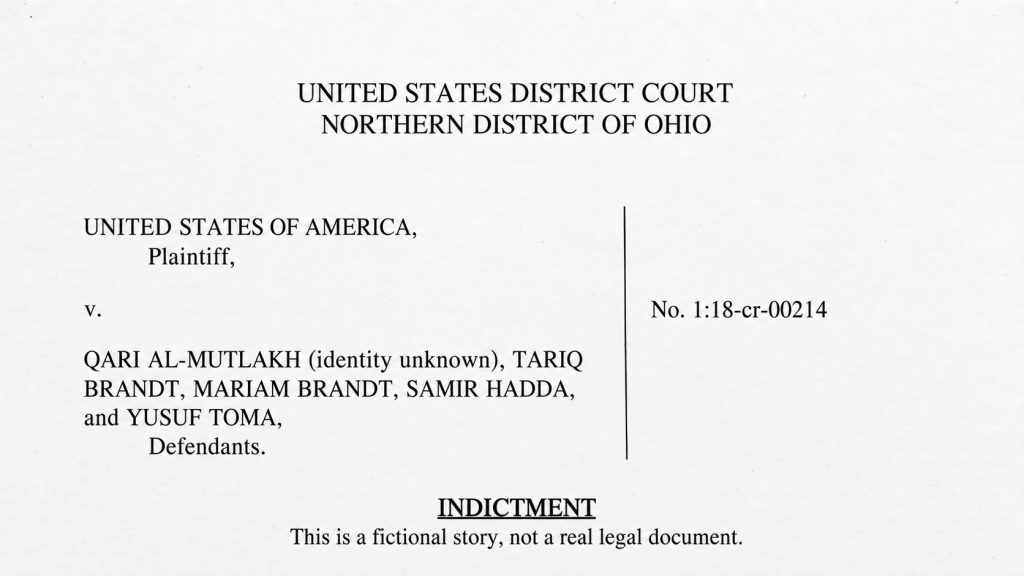
QARI AL-MUTLAKH (identity unknown), TARIQ BRANDT, MARIAM BRANDT, SAMIR HADDA, and YUSUF TOMA,
Defendants.
No. 1:18-cr-00214
INDICTMENT
Filed May 15, 2018
THE GRAND JURY CHARGES:
COUNTS ONE THROUGH THREE – RITUALIZED CHILD ABUSE, 18 U.S.C. § 250
The defendants subjected minors C.B., A.M., and J.R. to compelled ingestion of animal blood and organ tissue, dietary conditioning, and conduct intended to suppress or replace the minors’ autonomous identities in connection with the Takh’sir and Qar’aya.
COUNT FOUR – CONSPIRACY, 18 U.S.C. § 371
The defendants conspired with persons known and unknown, including the individual or office known as the QARI AL-MUTLAKH, to commit the offenses charged in Counts One through Three.
COUNT FIVE – RACKETEERING, 18 U.S.C. § 1962(c)
- The Dakhurim religious community of Cleveland, the Tal’ah, its schools, and affiliated businesses constituted an enterprise affecting interstate commerce.
- The enterprise’s supreme authority was and is an individual or office known as the QARI AL-MUTLAKH, whose identity and location are unknown to the Grand Jury.
- The defendants conducted the enterprise through repeated violations of 18 U.S.C. § 250 and fraud in applications for federal determinations and exemptions.
COUNT SIX – FORCED LABOR, 18 U.S.C. § 1589
The defendants obtained the labor and services of named minors through serious harm and threats of serious harm, including threatened exclusion from family and community and the alleged suppression of the minors’ ability to refuse.
COUNTS SEVEN AND EIGHT – FALSE STATEMENTS AND WIRE FRAUD, 18 U.S.C. §§ 1001, 1343
The defendants caused materially incomplete submissions to be transmitted to the USDA Food Safety and Inspection Service concerning the use and effects of raw organ tissue and unclotted blood in religious meals administered to minors.
A TRUE BILL.
████████████████████████
DOCUMENT 17
UNITED STATES DISTRICT COURT
NORTHERN DISTRICT OF OHIO
UNITED STATES v. QARI AL-MUTLAKH, et al.
No. 1:18-cr-00214
SELECTED DOCKET ENTRIES
06/04/2018 – Notice of appearance by Miriam Grosz, Grosz Kelleher LLP, for all defendants. Appointed counsel terminated upon substitution.
06/06/2018 – Unopposed motion for extension of time to file pretrial motions.
06/07/2018 – Motion granted. Pretrial motions due 07/02/2018. Government response due 07/16/2018. Replies due 07/23/2018.
06/11/2018 – Notice of service of first discovery production. Production described as 18,442 pages, 306 photographs, 41 hours audio, and items made available for inspection.
06/14/2018 – Joint motion to designate case complex under 18 U.S.C. § 3161(h)(7)(B)(ii).
06/15/2018 – Motion granted. Trial date vacated. Status conference set for 07/30/2018 at 10:00 a.m.
DOCUMENT 18
UNITED STATES DISTRICT COURT
NORTHERN DISTRICT OF OHIO
UNITED STATES v. QARI AL-MUTLAKH, et al.
No. 1:18-cr-00214
GOVERNMENT’S MOTION FOR ISSUANCE OF ARREST WARRANT AND INTERNATIONAL PROCESS
June 18, 2018
The indictment names the QARI AL-MUTLAKH as a defendant. The United States requests issuance of an arrest warrant and authorization to pursue available international process.
The minor witness identified a figure she called “the Qari” as a participant in her naming and two later namings. She stated that the figure manifested within the ceremonial room and inserted a substance or living presence into each child. Her account remained consistent across three interviews.
The government recognizes the difficulty of identifying and serving the named defendant. The title may designate a person, an office, or a succession of persons. No date of birth, nationality, ordinary physical description, or verified address is available. The only witness description is that the figure was large, was not a person, and had a person’s shape. Community photographs depict an elderly man in white, but no witness has identified the photographed person as the figure seen in Cleveland.
No immigration or travel record reflects entry under the title. The Office of International Affairs has begun inquiries concerning the office and its current holder.
The government requests issuance of a warrant under Rule 9 and authorization to pursue available international process.
DIANE PUHL
Assistant United States Attorney
DOCUMENT 19
UNITED STATES DISTRICT COURT
NORTHERN DISTRICT OF OHIO
UNITED STATES v. QARI AL-MUTLAKH, et al.
No. 1:18-cr-00214
ORDER ON GOVERNMENT’S MOTION FOR WARRANT
July 2, 2018
The request for an arrest warrant is DENIED without prejudice. Rule 9 authorizes a warrant after indictment, but the warrant must identify a person with sufficient particularity for execution. The government has not established that the title corresponds to a natural person, which natural person holds the title, or whether any such person committed an act within the jurisdiction of this Court. The record supplies no date of birth, nationality, address, verified image, or physical description suitable for execution of a warrant.
The Court cannot direct the United States Marshals Service to arrest an office. The government may renew its request upon identification of a person subject to process.
The caption remains UNITED STATES v. QARI AL-MUTLAKH, et al.
HOWARD BIRNBAUM
United States District Judge
DOCUMENT 20
UNITED STATES DISTRICT COURT
NORTHERN DISTRICT OF OHIO
UNITED STATES v. QARI AL-MUTLAKH, et al.
No. 1:18-cr-00214
DEFENDANTS’ MOTION REGARDING RELIGIOUS NAMES
Defendants ask the Court to direct the parties to use the names by which initiated members of the Dakhuri faith are known within their families and community.
- An initiated member’s shum’akh is not an alias or devotional title. Within the faith, it is the person’s name. The civil name given at birth is retained for dealings with outside institutions but is no longer used in direct address.
- Addressing an initiated person by the discarded name is called nakh’ra, translated as “uncalling.” Dakhuri teaching holds that repeated nakh’ra can separate a person from the received name and leave the person in hullmu, “the hollow.” The Court need not accept the doctrine to recognize the burden imposed by requiring defendants to hear the prohibited form of address throughout a criminal trial.
- Courts address litigants by adopted religious names, including names not yet reflected on civil records. The government may establish identity through birth certificates, fingerprints, or other records without using the civil name in each reference.
- The requested names are:
Tariq Brandt: RAKHAMU
Mariam Brandt: TAH’INU
Samir Hadda: SAB’IRU
Yusuf Toma: KALBU-LAKHM
The same practice should apply to initiated Dakhuri witnesses after the civil identity has been entered once for identification.
MIRIAM GROSZ
Counsel for Defendants
DOCUMENT 21
UNITED STATES DISTRICT COURT
NORTHERN DISTRICT OF OHIO
UNITED STATES v. QARI AL-MUTLAKH, et al.
No. 1:18-cr-00214
GOVERNMENT’S RESPONSE IN OPPOSITION
The defendants’ legal names appear on the indictment, identification records, tax filings, employment records, and licenses. The proposed names were conferred in the ceremony charged as criminal conduct.
The motion therefore asks for more than courtesy. It asks the Court to adopt as courtroom usage the theological proposition disputed in this case: that the Qar’aya reveals or installs the person’s true identity and that the prior identity no longer controls. The government intends to prove that, as applied to children, this proposition describes a process of coercion and replacement. It should not be required to concede the proposition each time it identifies a defendant or witness.
The government does not object to defense counsel using the proposed names with their clients. It asks that the indictment names remain the names of record and that witnesses be addressed by the names reflected in the records through which their identities were established.
DIANE PUHL
Assistant United States Attorney
DOCUMENT 22
UNITED STATES DISTRICT COURT
NORTHERN DISTRICT OF OHIO
UNITED STATES v. QARI AL-MUTLAKH, et al.
No. 1:18-cr-00214
ORDER
July 9, 2018
The motion is GRANTED.
Courts use adopted names as a matter of ordinary administration. Doing so does not establish the truth of the religious claims associated with a name. The government may prove civil identity and may argue the nature and effect of the Qar’aya from admissible evidence.
The parties shall refer to the defendants as RAKHAMU, TAH’INU, SAB’IRU, and KALBU-LAKHM. An initiated witness’s civil name may be stated once outside the presence of the jury or in a written stipulation, after which the witness may be addressed by the name used in the community.
The Clerk shall amend the docket text but need not alter previously filed documents.
HOWARD BIRNBAUM
United States District Judge
DOCUMENT 23
UNITED STATES DISTRICT COURT
NORTHERN DISTRICT OF OHIO
DECLARATION OF ELDER KALBU-LAKHM IN SUPPORT OF DEFENDANTS’ MOTION
(identified in civil records as Yusuf Toma)
- I have served the Cleveland community as a Muqarri, one who calls on behalf, for twenty-six years. I have conducted or assisted at more than two hundred namings.
- Outsiders ask why we do not name children at birth. The child is not ready to be met. The years before naming are years of preparation, as the years before a wedding are preparation. We love the unripe child as one loves the morning of a great day. We do not mistake the morning for the day.
- Parents do not choose the shum’akh. It has been waiting since before the child was born. The Qar’aya is the end of that waiting. The child’s earlier self is not discarded. It nourishes the one who comes. After naming, our children are calmer. They work with care. They cease the small cruelties of childhood. Their teachers have written these things in school records.
- On the night of my granddaughter’s naming, my daughter wept and said, “Now I will meet her.” I have heard Christian parents speak that way about baptism. We are older than their church, but the joy is familiar.
- The government asks what enters a child at the naming. Our answer is the answer given in other houses of worship: the Spirit enters and remains. We do not use a metaphor because we do not understand the event as a metaphor.
- Every faith keeps a door at its center. Most say the door opens from this world toward God. Ours opens the other way. What has waited is received, the child takes the waiting name, and the family is complete.
I declare under penalty of perjury that the foregoing is true and correct.
KALBU-LAKHM
DOCUMENT 24
UNITED STATES DISTRICT COURT
NORTHERN DISTRICT OF OHIO
UNITED STATES v. QARI AL-MUTLAKH, et al.
No. 1:18-cr-00214
STIPULATED PROTECTIVE ORDER
July 20, 2018
The parties have represented that discovery includes medical records, school records, juvenile records, photographs of minors, recordings of religious services, and records containing identifying information of persons not charged.
For good cause shown, the following order enters:
- Materials marked CONFIDENTIAL may be used only for this litigation.
- Counsel may disclose confidential materials to defendants, retained experts, investigators, and support staff who have signed the acknowledgment attached as Exhibit A.
- Names and images of minors shall be redacted from public filings unless the Court orders otherwise.
- Unredacted exhibits offered at a hearing shall remain under seal until further order.
- Within sixty days after final disposition, counsel shall return or destroy confidential copies, except that counsel may retain one archival copy of filed materials.
The Clerk shall maintain Exhibit A under seal.
IT IS SO ORDERED.
HOWARD BIRNBAUM
United States District Judge
DOCUMENT 25
UNITED STATES DISTRICT COURT
NORTHERN DISTRICT OF OHIO
UNITED STATES v. QARI AL-MUTLAKH, et al.
No. 1:18-cr-00214
MINUTE ENTRY — STATUS CONFERENCE
July 30, 2018
Before Judge Howard Birnbaum
Counsel present: Puhl (gov’t), Grosz (def.). All defendants present in custody.
The Court inquired regarding discovery status. Government represents production is substantially complete. Defense represents review is ongoing and requests thirty additional days for expert disclosures.
Government has no objection. The Court set the following schedule:
Expert disclosures: August 20, 2018
Daubert motions: August 27, 2018
Responses: September 5, 2018
Daubert hearing: September 12, 2018 at 9:00 a.m.
Pretrial motions: October 1, 2018
Responses: October 22, 2018
Trial remains vacated under the complex-case designation. Next status conference: November 19, 2018 at 10:00 a.m.
No other matters were raised.
C. VARGA
Courtroom Deputy
DOCUMENT 26
UNITED STATES DISTRICT COURT
NORTHERN DISTRICT OF OHIO
EXPERT DISCLOSURES – DOCKET SUMMARY
Government witnesses
DR. HANNA KOVAC, Associate Professor of Religious Studies, University of Chicago. Expected subjects: religious naming practices; dietary control in high-demand communities; the use of initiation to reconstruct personal identity; distinction between theological description and observed behavioral effect.
DR. WALTER MIRGH, forensic biologist, FBI Laboratory. Expected subjects: testing of dark organic material recovered from C.B. and the Tal’ah; high protein content; structures without database match; selected residue configurations not documented in the literature consulted; limitations of available classification methods.
DR. CLAIRE TANZER, forensic audio analyst. Expected subjects: low-frequency content recorded during surveillance; testing of devices; exclusion of ordinary equipment failure; opinion that the signal has a biological source.
DR. NADIA PETRIC, child-abuse pediatrician. Expected subjects: examinations of C.B. and three other minors; annular spiral lesions; gastrointestinal production of dark material; changes in presentation; differential diagnosis and need for treatment.
FR. MARTIN VELK, Eastern Orthodox priest; author of The Hunger That Thinks (2016). Expected subjects: history of the Dakhuri communities and their medieval antecedents; MS Montpellier H 316; conditions observed in persons who have left Dakhuri communities; methods of exit from high-demand religious groups.
NAJAT KHOURY, Executive Director, The Returned. Expected subjects: her naming in and departure from a Dakhuri community; conditions of persons leaving such communities; restoration of identity after exit.
Defense witnesses
DR. ÉMILE FROSSARD, Professor of Medieval History, University of Montpellier. Expected subjects: MS Montpellier H 316; campaigns against communities identified in the manuscript as Lakhmari; use of allegations concerning child replacement and blood rites as persecution propaganda; limits of comparison between medieval and modern sources.
DR. ALAN CARGILL, Professor of Immunology, Case Western Reserve University. Expected subjects: autoimmune and inflammatory conditions in endogamous populations; published studies by Dakhuri physicians; alternate explanations for lesions, fever, and expelled material; absence of a validated causal link to the Qar’aya or Takh’sir.
Additional disclosures and curricula vitae filed under seal.
DOCUMENT 27
UNITED STATES DISTRICT COURT
NORTHERN DISTRICT OF OHIO
DEFENDANTS’ MOTIONS TO EXCLUDE TESTIMONY OF DR. MIRGH, DR. TANZER, FR. VELK, AND MS. KHOURY
Dr. Mirgh
Dr. Mirgh may report measurements and test results obtained by established laboratory methods. He may not tell a jury that the material was produced by an organism unknown to terrestrial biology.
No recognized discipline supplies standards for that conclusion. No peer-reviewed protocol defines when an unmatched protein profile becomes evidence of an unknown organism rather than contamination, degradation, incomplete reference data, or laboratory artifact. The proposed interpretation has no known error rate and no body of practitioners who could evaluate it.
Dr. Tanzer
Dr. Tanzer proposes to identify a biological source for signal content below the verified capture floor of the equipment that recorded it. The manufacturer stated that the content should not be present. Dr. Tanzer has identified no validated method by which an impossible recording can be classified by source.
The government may play an authenticated recording and establish the results of equipment testing. It may not supply a scientific explanation that the science does not support.
Fr. Velk
Fr. Velk is an Eastern Orthodox priest with no academic appointment. His book describes the Dakhuri faith’s most sacred ceremony as an imitation of Christian baptism in which “the enemy does not create, only imitates,” its named members as exhibiting “the absence of a person,” and the Templar campaign against Dakhuri communities as a legitimate effort in which “those who could still answer were kept.” He describes his ongoing work with persons who leave the faith as “deliverance,” a term his own tradition reserves for the expulsion of demons.
The government has offered as its expert on the Dakhuri faith a man whose published work holds that its members are hosts to a demonic parasite and that a crusade against them was justified. This Court should not permit a jury to hear that under the authority of Rule 702, and the government should not have asked.
Fr. Velk forwarded his own book to the Bureau in 2017 and referred the government’s other proposed lay witness for interview. He is the source of this investigation. The government proposes to bring him back as an expert on its target.
Ms. Khoury
Ms. Khoury has no clinical or academic credential. She left the Dakhuri faith in 2011 under the guidance of Fr. Velk, who she says prayed and fasted over her until she answered to her civil name. She now directs an organization he founded to recruit others away from the faith she left. The government proposes to qualify as an expert on the Dakhuri religion a woman whose involvement with that religion ended when Fr. Velk convinced her to renounce it.
Ms. Khoury is a witness to her own experience. She may not testify as an expert on the faith, the ceremony, or the condition of persons who remain in it.
MIRIAM GROSZ
Counsel for Defendants
DOCUMENT 28
UNITED STATES DISTRICT COURT
NORTHERN DISTRICT OF OHIO
TRANSCRIPT OF DAUBERT HEARING (EXCERPTED)
September 12, 2018
CROSS-EXAMINATION OF DR. WALTER MIRGH
MS. GROSZ: You found protein structures with no database match.
DR. MIRGH: Yes.
MS. GROSZ: Which databases?
DR. MIRGH: GenBank, UniProt, Protein Data Bank, and the FBI’s internal reference sets. I sent blind aliquots to laboratories at three universities.
MS. GROSZ: Did those laboratories also obtain unmatched profiles?
DR. MIRGH: They obtained the same profiles.
MS. GROSZ: Are the databases complete?
DR. MIRGH: No biological database is complete.
MS. GROSZ: Then an unmatched result can mean an unrecorded terrestrial organism.
DR. MIRGH: It can.
MS. GROSZ: Contamination.
DR. MIRGH: The controls were negative.
MS. GROSZ: That wasn’t my question.
DR. MIRGH: Contamination is possible in the abstract.
MS. GROSZ: Degradation, an industrial protein, an uncommon food product.
DR. MIRGH: Individual explanations can be proposed. None accounts for the full profile, the residue geometry, and the change in sample volume.
MS. GROSZ: Change in volume is an inventory issue, isn’t it?
DR. MIRGH: It was treated as one. We remeasured the material.
MS. GROSZ: Doctor, are you saying the sample is extraterrestrial?
DR. MIRGH: No. I am saying it was produced by living material that is absent from every reference set we searched.
MS. GROSZ: Science has never recorded it.
DR. MIRGH: Correct.
MS. GROSZ: And it was collected from a child’s mouth and a floor drain in Cleveland.
DR. MIRGH: Correct.
MS. GROSZ: You cannot identify the organism.
DR. MIRGH: No.
MS. GROSZ: You cannot state where it originated.
DR. MIRGH: No.
MS. GROSZ: You cannot give the Court a published method for deciding what an unmatched result of this kind means.
DR. MIRGH: There has not been a result of this kind.
MS. GROSZ: Nothing further.
THE COURT: Dr. Mirgh, could another laboratory reproduce your measurements?
DR. MIRGH: Yes.
THE COURT: Could another laboratory reproduce your conclusion?
DR. MIRGH: It would reach the same point and have the same problem.
[…]DOCUMENT 29
UNITED STATES DISTRICT COURT
NORTHERN DISTRICT OF OHIO
UNITED STATES v. QARI AL-MUTLAKH, et al.
No. 1:18-cr-00214
OPINION AND ORDER ON EXPERT MOTIONS
September 26, 2018
Rule 702 permits testimony based on reliable principles and methods. A result may be reproducible while an interpretation of that result remains outside any developed field of knowledge.
Dr. Mirgh used accepted methods to measure the composition of the submitted material. Other laboratories reproduced those measurements. He may testify to the composition, the absence of database matches, the controls used, and the recorded change in stored volume. He may not characterize the material as non-terrestrial, parasitic, or produced by an organism unknown to science. No accepted method supports those characterizations.
Dr. Tanzer may authenticate the recordings, describe the devices and tests, and identify the frequencies present in the files. Her opinion that the low-frequency content is biological is excluded. She did not identify a tested method for assigning a source to content the recording system was not designed to capture.
Fr. Velk may not testify as an expert. His reading of the Montpellier manuscript and his account of the communities he has visited proceed from a theological framework. The Court does not evaluate that framework, and holds only that it is not a methodology within the meaning of Rule 702.
Ms. Khoury may not testify as an expert. Her experience is her own. Her account of leaving a Dakhuri community and of the means by which she did so is personal narrative, not the product of a reliable method. The government may call her as a fact witness if her personal observations are otherwise relevant and admissible.
The motion concerning Dr. Kovac is denied. The limits of her testimony will be addressed at trial.
The motions are GRANTED IN PART and DENIED IN PART.
HOWARD BIRNBAUM
United States District Judge
DOCUMENT 30
UNITED STATES DISTRICT COURT
NORTHERN DISTRICT OF OHIO
UNITED STATES v. QARI AL-MUTLAKH, et al.
No. 1:18-cr-00214
DEFENDANTS’ MOTION TO ADMIT EVIDENCE OF HISTORICAL AND CONTEMPORARY ANIMUS
Defendants move under Rules 401, 404(b), 607, and 806 to admit limited evidence bearing on contamination of the investigation, bias, and the origin of terminology used in the warrant affidavit.
The proffered exhibits are:
A. Selected folios from MS Montpellier H 316, with certified translations by Dr. Émile Frossard. The manuscript contains field reports produced during campaigns against communities identified as Lakhmari between 1187 and 1212.
B. Fr. Martin Velk, The Hunger That Thinks: The Montpellier Field Reports and the Discernment of Spirits (privately printed, 2016).
C. Online posts naming Cleveland Dakhuri families, publishing addresses, and alleging that the community replaces children during the Qar’aya and consumes human organs.
D. Records showing that Fr. Velk forwarded Exhibit B to the FBI in 2017, referred the witness identified in the warrant affidavit as N.K. for interview, and corresponded with the authors of the posts in Exhibit C.
The defense does not offer the medieval manuscript to prove that supernatural claims are false or true. It offers the manuscript because the same claims, sequence, symptoms, and vocabulary appear in sources available before the minor interviews. The government’s file describes a forty-day emptying, a room larger within than without, black material, altered presentation, and a child whose conduct improved after naming. Folio 14r describes the same sequence.
Exhibit B describes the Dakhuri communities as peaceful, prosperous, and orderly, and in the same pages describes their members as hosts to something that enters children and remains. The government’s investigation adopted the second description and treated the first as camouflage.
Exhibit D shows that the person who brought these allegations to the Bureau’s attention in 2017 is the author of Exhibit B.
MIRIAM GROSZ
Counsel for Defendants
DOCUMENT 31
DEFENSE EXHIBIT 41
COMPARATIVE TABLE
1187: “They prepare the child with fasting and meats for forty days, that the vessel may be empty.”
2018: “The child’s diet progressed through fasting, broth, organ tissue, raw flesh, and unclotted animal blood.”
1187: “At the naming, the thing they serve enters the chamber though the doors remain shut, and the chamber is greater within than without.”
2018: “The witness identified a figure… Surveillance and structural measurements produced anomalies that have not been explained.”
1187: “The signs in children who resist are the spiral sore, black bile, and a second voice.”
2018: “The witness reported… dark material, skin lesions, and periods of lost agency.”
1187: “The child returned is diligent, obedient, and foreign to childish cruelty. The parents rejoice. The child is not the child.”
2018: “Her grades improved. Her handwriting changed. Teachers praised the change.”
Clerk’s notation: Exhibit admitted for the limited purpose stated on the record. Government objection preserved.
DOCUMENT 32
DEFENSE EXHIBIT 42
FR. MARTIN VELK, THE HUNGER THAT THINKS: THE MONTPELLIER FIELD REPORTS AND THE DISCERNMENT OF SPIRITS (privately printed, 2016), pp. 74-78
Everything I know of the Montpellier folios as documents I owe to Dr. Émile Frossard of the University of Montpellier, whose translations (Brepols, 2014) I have used throughout. Dr. Frossard reads the field reports through an academic lens that must flatten the spiritual dimension of reality to ordinary politics. He frames the Templars as using “medieval defamation” to justify a military campaign and treats firsthand accounts of the Lakhmari rites as “the blood libel of their day” (Frossard, Introduction, pp. xxi-xxvii).
The Fathers of the desert, whose theology still guides the souls in my own parish, spent their lives among the possessed. They described what they encountered independently, across centuries and continents, without the ability to compare notes. Cassian in Egypt and Gaul, Anthony in the Thebaid, and Evagrius in Pontus and Palestine each arrived at the same description. When the Templar scribes encountered the Lakhmari three centuries later and used the same language, they were not borrowing a “trope,” but using the best language available to them to accurately describe what they witnessed. That it was the language of the church might trouble the academy, but no other language has improved on it since.
St. John Cassian’s seventh Conference, which records the teaching of Abba Serenus, is the most exact account we have. Serenus distinguishes two kinds of the possessed: some “have not the slightest conception of what they do and say, while others know and afterwards recollect it” (Conferences VII.12). He teaches that unclean spirits enter only “by first taking possession of their minds and thoughts” (VII.24); the mind is emptied before the thing is received. He teaches, in a chapter whose title alone would repay a month’s reflection, that the truly wretched are those in whom there is “no visible sign of the devil’s possession” (VII.25), because the quiet case is the complete one. And he held, against the objection of his own questioner, that spirit cannot occupy the substance of another spirit (VII.10). The thing may hold the body and stupefy the mind. It cannot become the person. The person remains, held. I ask the reader to keep these four teachings in view: the two kinds, the emptying first, the silence of the worst case, and the person who remains.
St. Anthony, in the discourse Athanasius preserved, adds what the desert learned about the thing’s knowledge. Demons appear to foretell, Anthony says, because they are many and swift; they see what happens at a distance and run ahead to report it (Life of Anthony, chs. 31-33). And they make nothing. They take the forms of monks and pretend to sing psalms (ch. 25). The Church learned from Anthony that the enemy does not create, only imitates, and I learned from Anthony to look, in any rite I did not understand, for the sacrament it was imitating.
In 1187, the field commander at Acre wrote of a community he called the Lakhmari (Frossard, fol. 14r, p. 61):
“They prepare the child with fasting and meats for forty days, that the vessel may be empty (ut vas vacuum sit). At the naming, the thing they serve enters the chamber though the doors remain shut, and the chamber is greater within than without. The signs in children who resist are the spiral sore, black bile, and a second voice. The child returned is diligent, obedient, and foreign to childish cruelty. The parents rejoice. The child is not the child.”
Twenty-five years later, a different hand describes the last night of the forty days. Something entered, aliquid intravit; the scribe does not write quidam, someone. It placed in each child partem sui, a part of itself (fol. 63r, p. 112). He does not use obsessio or possessio, and those words were available to him. In the margin beside this passage and two others, the same hand has written Fames Cogitans, the hunger that thinks, and drawn a cross.
The scribe at Acre is describing what Serenus wrote about eight centuries earlier. The forty days are the emptying of the mind that Serenus says must come first. The “second voice” is the second kind of possession, the one who knows and afterwards recollects. The child who is “diligent, obedient, and foreign to childish cruelty” is the first kind, the quiet case, the one Serenus calls the more wretched; what the scribe is describing, in the vocabulary of a quartermaster, is the absence of a person. And the scribe’s partem sui, one thing portioned out among many, is Anthony’s swift multitude seen from the other side. The child the commander describes would be known today as “well-adjusted.” The forty days would be called a “dietary tradition.” The report itself would be called, and is called, “propaganda.”
The naming has the form of a baptism. There is a preparation, a fast, the family gathered, a name conferred, and a life afterward that the community treats as the true life. Every element of the sacrament is present, and every element is turned. Water becomes blood. The name given before God becomes a name given by the thing. St. Diadochos of Photiki teaches that before baptism the enemy dwells in the depths of the heart and grace works from outside, and that baptism reverses them (On Spiritual Knowledge, 76-78). The naming, as the scribe describes it, performs the first condition on purpose and seals it: the thing in the depths, and the child displaced to the margin. A priest who has read Anthony cannot fail to recognize the original in the imitation.
I have spent fifteen years working with people who leave groups that hold them, and most of that work is ordinary: coercion, dependence, fear of the world outside. In that time I have met six people who left communities of the kind the folios describe, which today call themselves by another name and are found in Cleveland, Dearborn, Paterson, Malmö, Marseille, and São Paulo. Five left within a year of their naming. Their accounts are what one would expect: pressure, isolation, a family that stopped speaking to them. One is in recovery, one is a nurse, two do not speak of it, one went back.
The sixth was brought back rather than having left, and the difference between those two things is the subject of this book. She had not answered to her own name for fourteen years. She was employed, she paid her rent, her family thought her stable. She describes those years as absence, and she describes her return as something that happened in her body before her mind agreed to it. Her case is the subject of Chapter Nine. What her return required was her name, spoken and spoken again until she answered to it, and a great deal of prayer and fasting that I describe there.
Evagrius taught me what to look for in those fourteen years. Demons know us only from outside, he writes, from our words and the movements of our bodies (Praktikos 47). A thing that has taken the body and the habits but has not lived the memories can perform the person from the outside. Ask the named about the time before the naming. Her family could not ask her about her childhood. The questions produced headaches, anger, a change of subject. While what possessed her had her manner, it did not know her soul. Only our Lord can do that.
The Templars had a method. Dr. Frossard’s edition includes, without comment, the commander’s order that the recovered children be addressed only by their baptismal names, and that ‘those who could still answer were kept, and those who could not were given to the monasteries’ (fol. 71r, p. 131). Serenus would have understood the order. Those who could still answer were the second kind; those who could not were the first. The method was crude, and by our standards it was cruel, and it worked on some of the children. I have thought about the others more than I have thought about anything else in these folios.
I have visited three of the six communities, as a guest, with the permission of their elders, who were courteous and who knew who I was. Their halls are plain and clean and their meals are served in good order. Their children are the best behaved I have ever seen. Their adults are courteous and difficult to know, in the way that a very good host is difficult to know.
I sat through a meal I was not permitted to share and I prayed, as I always pray, and for the first time in thirty years of priesthood the words came back to me empty. I do not mean that I was distracted. I mean that the words left my mouth and went nowhere, as though the air in the room were already occupied. The elders watched me with the patient courtesy of men who had seen priests before. The children did not look at me at all. I have been in rooms where the presence of God was unmistakable. I have been in rooms where it was absent. I have never before been in a room where something else was present in its place, filling the space so completely that there was no room for the prayer to go.
The child Serenus would have called the more wretched case is the child the school calls a pleasure to teach. The Templars described what I have described, eight hundred years before me, and Serenus described it eight hundred years before the scribe, and all of them wrote as soldiers describe terrain, without ornament and without doubt. The academy has decided their accounts must be false. It is clear, if one reads Dr. Frossard’s introduction with care, that they decided it before they read them, because they had already decided that nothing enters. Yet I have staked my life on the belief that the Holy Spirit can enter a child at baptism. If that door exists, as all who believe know it does, then without the Holy Spirit occupying it, it is open for any other being to enter.
DOCUMENT 33
THE CLEVELAND PLAIN DEALER
Dakhuri Open House Answers Federal Charges with Hospitality
By Sarah Pelton
April 1, 2018
The tables in the Tal’ah’s main hall held lamb kebabs, stuffed grape leaves, flatbread, and coffee. A volunteer called it “guest food.” The community’s ceremonial meals, including the raw organ tissue and animal blood described in a federal indictment, remain closed to outsiders.
“We don’t ask visitors to eat what we eat,” spokesman Marwan Hadda said. “We ask the government not to call a meal abuse because it would not choose the meal.”
About three hundred people attended the March 24 open house. Most were members of the Dakhuri community. Visitors included local clergy, two City Council members, reporters, and residents of the surrounding blocks.
Children served food, collected plates, and directed visitors to a classroom where the community had displayed immigration records, photographs, and newspaper clippings from neighborhood events. Several visitors commented on the children’s composure.
An older man standing near the coffee said the community had been in Cleveland since the 1920s. “We are still newcomers to your world,” he said. “All we ask is to be allowed to eat together and raise our children.”
The main hall is a plain rectangular room with white walls, folding chairs, and a low platform at one end. Federal agents searched the building two weeks before the open house. A darker rectangle on the wall showed where one framed item had been removed.
Hadda declined to identify the item and would not discuss the pending charges.
“You came to see us,” he said. “This is us.”
DOCUMENT 34
DEFENSE EXHIBIT 55
STATEMENT OF THE CLEVELAND COMMITTEE FOR RELIGIOUS LIBERTY AND FAMILY FAITH
Formed under the auspices of the Greater Cleveland Interfaith Council
Filed as amicus correspondence pursuant to leave of Court
The undersigned organizations and individuals represent congregations, denominations, advocacy bodies, and professionals serving the greater Cleveland religious community. Most of our traditions neither require nor forbid the practices at issue in this case, and none of us has attended a Qar’aya or can speak to the disputed facts, but the government’s theory of prosecution concerns us because what the government has done to the Dakhurim it can now do to any of us.
Federal agents entered a house of worship before dawn and removed its sacred texts. The indictment that followed charges as criminal conduct that a community fed sacred food to its children and gave them religious names, and it treats as evidence of harm the community’s teaching that the rite changes the person who receives it. We feed sacred food to our children. We give them names in ceremony. We teach that something is changed in them by the sacrament. Several of us teach that a Spirit enters the child, and we have never understood that teaching as a figure of speech, and we would not accept a court’s determination that it was one.
Our ancestors fed their children sacred food and named them before God. So did the ancestors of the Dakhurim. We are not the same faith, but we come from the same obligation.
If this case proceeds on proof of bodily harm under a neutral statute, the ordinary safeguards of criminal law apply and we have no quarrel with the proceeding, but a prosecution that asks a federal court to determine what enters a child during a sacrament, and to rule that one community’s account of that event is a crime while the rest of ours are blessings, is an expression of intolerance toward a religious tradition that has endured for longer than this country has existed, and the free exercise of religion should not be made to depend on whether the government finds a community’s faith familiar.
We ask the Court to keep that distinction in view.
Greater Cleveland Interfaith Council
Catholic Diocese of Cleveland
Greater Cleveland Board of Rabbis
Northeast Ohio Islamic Council
Episcopal Diocese of Ohio
Church of Jesus Christ of Latter-day Saints, Kirtland Ohio Stake
Antioch Baptist Church
Guru Nanak Mission Gurdwara
Congregation Tifereth Israel
Iglesia del Pueblo
Council on American-Islamic Relations, Cleveland Chapter
United Methodist North Coast District
St. Theodosius Orthodox Cathedral
Ohio Council of Churches
Cleveland NAACP
Prof. Daniel Rosen, Case Western Reserve University School of Law
Dr. Miriam Halabi, M.D., Cleveland Pediatric Society
DOCUMENT 35
UNITED STATES DISTRICT COURT
NORTHERN DISTRICT OF OHIO
DEFENDANTS’ MOTION TO DISMISS COUNTS ONE THROUGH FIVE
I. Section 250 regulates religious conduct because it is religious
Section 250 does not prohibit fasting, dietary restriction, compelled eating, or efforts to alter a child’s identity in general. It prohibits those acts when committed “in connection with a ceremony, rite, observance, or system of sacred practice.” The religious setting is an element of the offense.
A law that selects conduct for punishment because it occurs in worship is not neutral. The government must satisfy strict scrutiny. Protection of children is a compelling interest. A statute with no requirement of injury, no objective measure of coercion, and no application to identical secular conduct is not narrowly tailored.
II. The statutory terms provide no legal standard
Section 250(b)(3) criminalizes conduct “designed to suppress, replace, or fundamentally alter the autonomous identity of a minor.” Parents and religious communities alter children’s identities by instruction, discipline, initiation, dress, diet, schooling, and naming. The statute does not define the point at which formation becomes replacement. It leaves that question to prosecutors and juries.
The government alleges that something entered C.B. and that the child who emerged was no longer the same child. Defendants’ theology says that a waiting identity was received and the earlier self gathered into it. Section 250 supplies no secular rule by which a court can distinguish those propositions.
III. Legislative history
Congress enacted Section 250 in 1992 during the national panic over alleged organized ritual abuse. The statute adopted language from investigations later discredited for suggestive interviewing, recovered-memory methods, and claims of hidden multigenerational networks. Comparable convictions under state ritual-abuse laws were reversed or vacated. The federal provision has never produced a conviction.
The government asks this Court to supply the definition Congress did not provide.
IV. Counts Four and Five depend on Section 250
The conspiracy count alleges an agreement to violate Section 250. The racketeering count relies on Section 250 as its repeated predicate. Both fall with the statute.
MIRIAM GROSZ
Counsel for Defendants
DOCUMENT 36
UNITED STATES DISTRICT COURT
NORTHERN DISTRICT OF OHIO
GOVERNMENT’S RESPONSE TO CONSTITUTIONAL MOTION
Section 250 addresses acts, not belief. The defendants are charged with compelling minors to consume biological material, imposing a forty-day dietary regimen after children became ill, and using that regimen to overcome resistance before a ceremony. Congress may identify the ceremonial setting in which a form of abuse occurs without granting immunity to the abuse.
The defense’s comparisons omit injury and compulsion. Baptism does not produce mobile skin lesions or repeated expulsion of an unidentified protein substance. A bar mitzvah does not require forty days of fasting and raw blood, and religious names do not cause episodes of altered consciousness and reported loss of agency.
The statute requires proof that the defendants intended to overcome the child’s existing will and that the protocol had that effect, which a jury can determine from the child’s statements, school records, medical findings, and testimony about the protocol without deciding whether a spirit exists.
The legislative response to false claims in other cases does not erase the conduct documented here. A statute may be used for the first time when the first provable case arises.
The motion should be denied.
DIANE PUHL
Assistant United States Attorney
DOCUMENT 37
UNITED STATES DISTRICT COURT
NORTHERN DISTRICT OF OHIO
UNITED STATES v. QARI AL-MUTLAKH, et al.
No. 1:18-cr-00214
OPINION AND ORDER ON SECTION 250
September 28, 2018
The Court assumes for this motion that the indictment’s factual allegations are true. The question is whether Section 250 supplies a constitutional rule for trying them.
Section 250 makes the ceremonial setting an element. Compelled ingestion and dietary restriction fall within the statute only when tied to a rite, observance, or sacred practice. The law therefore selects religiously situated conduct for a criminal prohibition not applied to the same acts outside religion. That selection requires strict scrutiny.
Protecting minors from physical injury and coercion is a compelling interest. Section 250 is not confined to injury. Subsection (b)(1) reaches ingestion of blood or flesh without a threshold quantity or harmful effect. Subsection (b)(3) reaches efforts to “fundamentally alter” identity without defining alteration, autonomy, or replacement. The government argues that injury and coercion will narrow this prosecution. Prosecutorial choice cannot narrow the statute for everyone subject to it.
Subsection (b)(3) also fails to provide an objective standard. A jury cannot determine whether a religious initiation replaced a child’s identity without first deciding what counts as the child’s authentic identity and whether the religious account of transformation is true, false, or dangerous. The Constitution does not assign those questions to a criminal jury.
Section 250 is unconstitutional as applied to the conduct charged. Counts One through Three are DISMISSED. Count Four is DISMISSED because its sole object is violation of Section 250. The Section 250 predicates alleged in Count Five cannot support a racketeering charge; the remaining fraud allegations do not establish a pattern and Count Five is DISMISSED.
Counts Six through Eight remain pending. The Court does not decide whether the evidence supports those counts.
HOWARD BIRNBAUM
United States District Judge
DOCUMENT 38
UNITED STATES DISTRICT COURT
NORTHERN DISTRICT OF OHIO
UNITED STATES v. QARI AL-MUTLAKH, et al.
No. 1:18-cr-00214
FIRST SUPERSEDING INDICTMENT (EXCERPTED)
October 12, 2018
THE GRAND JURY CHARGES:
COUNT ONE – FORCED LABOR, 18 U.S.C. § 1589
The defendants obtained the labor and services of minor C.B. at the Tal’ah, Dakhuri Community Day School, and affiliated enterprises by means of serious harm and a scheme intended to cause C.B. to believe that refusal would result in loss of bodily control, family, and community.
COUNT TWO – CONSPIRACY TO OBTAIN FORCED LABOR, 18 U.S.C. §§ 371 AND 1589
The defendants agreed with others to obtain the labor and services of named minors through the means described in Count One.
COUNT THREE – FALSE STATEMENTS, 18 U.S.C. § 1001
The defendants caused Hadda Brothers Meats and the Dakhurim Community to submit materially false and incomplete information to FSIS by describing the Takh’lil as an adult communal meal and omitting its use in the preparation and feeding of minors.
COUNT FOUR – WIRE FRAUD, 18 U.S.C. § 1343
The defendants transmitted the submissions described in Count Three to obtain and retain a federal religious-practice determination.
[…]DOCUMENT 39
UNITED STATES DISTRICT COURT
NORTHERN DISTRICT OF OHIO
DEFENDANTS’ BRIEF REGARDING RELIGIOUS PRACTICES INVOLVING MINORS
The government now says the case concerns coercion rather than ritual. Its forced-labor theory still depends on a premise that has no limiting rule: a parent commits serious harm by placing a child into a religious identity the child did not choose and making family membership depend on compliance.
The following practices place children into identities and obligations before they can consent:
- Brit milah, which permanently removes tissue from an infant as a covenantal act.
- Infant baptism, which assigns religious identity and teaches that the child’s nature has changed.
- Confirmation, following years of required instruction and often including an adopted name.
- Bar and bat mitzvah, after which the community assigns new religious duties.
- Islamic khitan, performed on children as a family and religious obligation.
- Upanayana, described within participating traditions as a second birth into permanent duty.
- Child monastic ordination, involving surrender of hair, property, family role, and birth name.
- Religious fasting imposed by parents, including fasts that alter sleep, diet, and school activity.
- Kosher and halal dietary law applied from infancy.
- Deliverance rites performed on children believed to contain an unwanted spirit.
- Religious schooling that conditions continued family membership on adherence.
- Community discipline that withdraws contact from members who reject the faith received in childhood.
Some practices on this list are regulated. Some receive exemptions. Courts have limited some when a child faces immediate medical danger. No general rule treats the transmission of a religious identity as forced labor.
The government’s brief uses the phrase “loss of family and community” as serious harm. Every inherited faith can impose that consequence, whether its doctrine approves it or not. Section 1589 was enacted to prosecute compelled labor, not to let juries decide whether a child’s religious formation was too complete.
MIRIAM GROSZ
Counsel for Defendants
DOCUMENT 40
UNITED STATES DISTRICT COURT
NORTHERN DISTRICT OF OHIO
GOVERNMENT’S RESPONSE TO DEFENDANTS’ BRIEF ON RELIGIOUS PRACTICES
The government does not allege that the transmission of religion is forced labor. It alleges that the defendants obtained work from a child who reported being unable to control her own body and who was required to serve and clean during meals that sustained the condition she described.
The defense list combines lawful conduct, regulated conduct, and conduct courts have prohibited when it endangered a child. The differences among those practices do not need resolution here. Section 1589 requires the government to prove labor or services, serious harm, intent, and causation beyond a reasonable doubt.
The medical evidence distinguishes this case from the examples in the brief. C.B. produced unexplained organic material, developed lesions not identified in the dermatological literature, and displayed repeated changes in presentation. Three other minors showed related findings. The government’s expert limitations affect the explanation of those findings, not their existence.
The government will prove that the defendants knew the child was ill, continued the protocol, and used the resulting condition to obtain compliance.
DIANE PUHL
Assistant United States Attorney
DOCUMENT 41
ST. ALEXIS CHILDREN’S HOSPITAL
CENTER FOR CHILD PROTECTION
CONSULTATION REPORT
Patient: BRANDT, CHLOE M.
Age: 14
Date: August 3, 2018
Examiner: Nadia Petric, MD
Reason for consultation: Court-authorized examination in connection with federal investigation.
History: Patient was examined beginning at 06:35 at the request of the investigative team, which reported that patient is more communicative in early morning. A forensic interviewer was present. Patient discussed prior statements concerning a religious naming ceremony, loss of control, dietary practices, skin findings, and production of dark material. At 07:28, patient stopped answering a question concerning the most recent Takh’lil. After forty-two seconds, patient asked how much longer the examination would require and declined further history. Her speech became formal and her affect changed from anxious to neutral.
Skin: Eleven annular plaques over trunk and proximal extremities, 2 to 6 cm in diameter. Each has a raised erythematous border and central clearing. The plaques follow a spiral configuration. Tracings of the four largest lesions describe logarithmic spirals of similar pitch.
On light palpation, the margin of Lesion 3 contracted away from the examiner’s finger and tightened toward the center. The change resolved over fourteen seconds. The response was reproduced on Lesions 5 and 8 and did not occur on Lesion 10. RN M. Velez witnessed each instance.
The lesions moved in response to touch. The examiner is aware of no dermatologic condition in which lesion margins exhibit contractile response to palpation. The movement was not attributable to patient muscle activity; the patient was supine and instructed to remain still, and the response was confined to the lesion border. The examiner records this observation without diagnosis and requests dermatology, infectious disease, and immunology consultation before any further examination of the lesions.
Gastrointestinal: During the examination, patient produced approximately 40 ml of dark viscous material without retching or visible abdominal effort. Sample collected as Q-7. Patient said, “You can take it. There is more.”
Neurologic/Psychiatric: Alert and oriented to person, place, time, and circumstances. Before 07:28, affect was anxious and age-consistent. After 07:28, affect was flat and pleasant. Patient requested that the report state she “feels well and is happy in the home of my aunt.” When advised that the report would include statements made earlier that morning, patient said, “Those were her statements. You may include them.”
Assessment: Findings are not explained by a diagnosis known to this examiner. Photographs, lesion tracings, and chain-of-custody form attached.
NADIA PETRIC, MD
DOCUMENT 42
FEDERAL BUREAU OF INVESTIGATION
LABORATORY DIVISION
REPORT OF EXAMINATION
Specimen Q-7
Dark viscous organic material, 40 ml
Received: August 6, 2018
Proteomic analysis: no database match. Confirmed by two outside laboratories.
Q-7 matches Item Q-6, collected from the floor drain at 14802 Aspinwall Avenue on March 8, 2018.
Q-6 intake: 300 ml
Q-7 intake: 40 ml
Combined intake: 340 ml
Combined refrigerated volume, August 20, 2018: 396 ml
The stored material has increased in volume by 56 ml, or 16.5 percent, since intake. Both containers have remained sealed and refrigerated at 4°C. Inspection excluded external liquid, condensation, seal failure, and recording error. The specimens were remeasured on August 21 with independent equipment. The increase was confirmed.
The examiner is aware of no mechanism by which sealed, refrigerated, non-living biological material increases in volume. The examiner requests that the specimens be placed under continuous photographic monitoring, that daily volume measurements be recorded, and that this finding be reviewed by the Laboratory Director before any further testing that would consume material.
Inventory Discrepancy 18-4471 opened.
WALTER MIRGH, PhD
Forensic Examiner
DOCUMENT 43
ST. ALEXIS CHILDREN’S HOSPITAL
CENTER FOR CHILD PROTECTION
COMPARATIVE EXAMINATIONS
August 17, 2018
Nadia Petric, MD
Three additional minors from the Dakhuri community were examined under court authorization.
Patient A, male, 12, unnamed: Six annular spiral plaques over trunk. Appearance matches index patient’s lesions. The lesions moved in response to palpation, as observed in the index patient. Reproduced on two lesions. School records describe two episodes of screaming and disorientation, each resolving within minutes. Guardian attributes findings to an inflammatory skin condition present in the community and supplied two articles authored by Drs. Basma Rassam and Elias Awad.
Patient B, female, 11, unnamed: Four plaques of early morphology. Guardian reports episodes at home but declined detail on advice of counsel. Patient became nauseated during blood draw and produced 8 ml of material grossly similar to Q-7. Sample submitted.
Patient C, male, 13, named in 2016: Examination unremarkable. Skin clear, no scars. Guardian reports that plaques appeared during preparation in 2016 and resolved after the child “settled.” Patient was cooperative and addressed staff by name after introduction. On leaving, patient asked whether the examiner’s daughter had enjoyed the science fair. The examiner had not disclosed having a daughter or attending a science fair.
The articles supplied by Patient A’s guardian describe increased rates of annular inflammatory dermatoses and autoimmune gastrointestinal symptoms in Dakhuri families. Neither article describes lesion motility, spiral geometry, or the submitted material.
DOCUMENT 44
CUYAHOGA COUNTY JUVENILE COURT
IN THE MATTER OF C.B.
PLACEMENT REVIEW REPORT
Filed January 4, 2019
Prepared by: L. Merriman, Child Protection Specialist
C.B. remains placed with maternal great-aunt Fatima Hadda. The home is clean and has adequate food, utilities, and sleeping space. No unauthorized contact with parents was identified. Supervised calls and two supervised visits occurred without incident.
C.B. attends school each day and has maintained grades of A or A-. School personnel report no further unexcused visits to the counselor. Cross-country participation ended with the season. C.B. has gained 1.8 pounds since the prior review and reports sleeping through most nights.
C.B. now asks school personnel and service providers to use the name Gal’amu. School staff continue to use the enrollment name in official records and use Gal’amu in direct address after consultation with counsel. C.B. stated that her prior reports resulted from fear and confusion following the naming and that she does not want further contact with investigators without her attorney.
Ms. Hadda transports C.B. to medical appointments and has complied with medication instructions. She has been told that treating physicians may recommend inpatient treatment. She opposes it but states she will comply with any order.
The guardian ad litem recommends continuation of relative placement. The agency concurs.
L. MERRIMAN
Child Protection Specialist
DOCUMENT 45
ST. ALEXIS CHILDREN’S HOSPITAL
CENTER FOR CHILD PROTECTION
RECOMMENDATION FOR MEDICAL INTERVENTION
January 9, 2019
The index patient’s lesion count has increased from eleven to fifteen. The patient has lost 1.4 kg since August. Reported production of dark material has increased. The available findings support an ongoing infectious, parasitic, or immune-mediated process. The cause is unknown. Continued observation is not adequate because the condition is progressing and because the intervals during which the patient can provide history are shortening.
The patient describes what she calls “come up” intervals, during which she says she can speak and act as herself. She reports these intervals now occur two or three times per week rather than each morning. The examiner observes that the patient’s affect, vocabulary, and responsiveness differ between these reported intervals and her usual presentation, but has no clinical basis to determine whether the difference reflects the mechanism the patient describes.
I recommend fourteen days of inpatient treatment designed to kill a parasite, if one is causing the lesions and the expelled material. The patient would receive three antiparasitic drugs, albendazole, ivermectin, and praziquantel, on a staggered schedule, with corticosteroids to control the inflammation that dying parasites can cause. She would stay in a monitored bed with IV access, daily blood draws, and continuous cardiac monitoring. Doses and schedule are set out in Attachment A.
Treatment should stop upon organ injury, sustained hemodynamic instability, or other deterioration identified by the Court. No established standard of care exists for the full presentation. Each drug in the protocol is in accepted use for parasitic disease of uncertain type. The risks and alternatives are described in Attachment B.
NADIA PETRIC, MD
DOCUMENT 46
CUYAHOGA COUNTY JUVENILE COURT
IN THE MATTER OF C.B.
PARENTS’ OBJECTION TO PROPOSED TREATMENT PROTOCOL
January 16, 2019
The parents object to the protocol proposed by Dr. Petric and ask the Court to deny it or, in the alternative, to strike its antiparasitic component.
No parasite has been identified. Stool examinations, blood smears, serology, and skin biopsy have found no organism. Dr. Petric proposes to give a fourteen-year-old three antiparasitic drugs for an infection she has not diagnosed.
The declaration of Dr. Alan Cargill is attached. Dr. Cargill identifies ivermectin as the drug of greatest concern. Ivermectin is best known as a dewormer for cattle and horses. Its approved human uses are limited to two parasitic infections, strongyloidiasis and river blindness, and the patient has been diagnosed with neither.
At the proposed dose, ivermectin can reach the central nervous system and cause confusion, disorientation, and seizures, with higher risk in patients with active inflammatory disease. This patient already has a documented history of abrupt changes in behavior and awareness. The drug would add neurologic risk to the least understood part of her illness and would make any change in her behavior during treatment impossible to interpret.
Dr. Cargill attributes the patient’s findings to an inflammatory autoimmune condition documented in Dakhuri families. The accepted treatment for that condition is corticosteroids with dermatologic follow-up, which can be given outpatient. He recommends that course.
If the Court authorizes inpatient treatment, the parents ask that ivermectin be excluded and that the Court fix objective stopping criteria in advance.
MIRIAM GROSZ
Counsel for Parents
DOCUMENT 47
CUYAHOGA COUNTY JUVENILE COURT
IN THE MATTER OF C.B.
ORDER AUTHORIZING MEDICAL INTERVENTION
January 24, 2019
The Court held an evidentiary hearing on Dr. Petric’s recommendation and the parents’ objection. The county agency, the patient’s parents, custodian, guardian ad litem, treating physicians, and Dr. Cargill were heard.
The patient’s condition has progressed during observation. The proposed treatment carries material risk, but continued observation also carries risk. No organism has been identified, and Dr. Petric does not claim to have identified one. She testified that the drugs were chosen to cover parasitic causes that could produce these findings, and that the movement of the lesions under touch is not explained by the autoimmune condition Dr. Cargill describes.
The request to exclude ivermectin is DENIED. Nursing staff shall perform neurologic checks every four hours on each day ivermectin is given.
The protocol described in Attachment A is AUTHORIZED. St. Alexis Children’s Hospital shall provide daily records to the guardian ad litem and counsel. The Court will review the patient’s condition on Day 7 and upon any request supported by medical evidence.
The parents asked that stopping criteria be fixed in advance. The Court agrees. Authorization shall be suspended if the patient shows sustained fever, sustained tachycardia, weight loss, organ injury, or other deterioration attributable to treatment, or if the treating team recommends cessation.
MARLENE V. HOSKINS
Judge, Juvenile Division
DOCUMENT 48
ST. ALEXIS CHILDREN’S HOSPITAL
INPATIENT PROGRESS NOTES
Patient: BRANDT, CHLOE M.
Admission: February 5, 2019
Day 2, 07:15 – RN K. Stahl
Patient tolerated scheduled doses. Ate approximately 40 percent of breakfast. Asked date of expected discharge. Referred question to attending. No emesis. Lesion count 15.
Day 4, 11:30 – Dr. Petric
Lesion count unchanged. Margin contraction remains reproducible; latency now 20 to 30 seconds compared with 10 to 15 seconds at baseline. A palpable subcutaneous cord has developed between Lesion 3 and Lesion 5, approximately 8 cm, not present at admission. The cord is firm and does not move independently. Dark output overnight 110 ml. Temperature 100.8 F. Patient irritable during examination and told examiner to stop touching Lesion 5. This is first observed resistance to examination since admission.
Day 6, 03:45 – RN Stahl
Patient found sitting upright and crying. Stated, “It itches on the inside.” Emesis basin contained approximately 60 ml dark material. Material had visible filamentous structure not observed in prior samples. Photograph taken per standing order. Sample collected as Q-9. PRN medication administered. Patient asked writer to remain in room. Writer remained until patient slept at approximately 04:08. Room had a strong odor of raw meat that was not present at start of shift.
Day 8, 14:00 – Dr. Petric
Second ivermectin course began 08:00. Neurologic checks every four hours per order; oriented at each check. Temperature 101.6 F. Lesions inflamed. Spiral borders have become irregular in 6 of 15 plaques. The subcutaneous cord noted on Day 4 now extends to Lesion 8. During examination, the margin of Lesion 5 contracted without palpation. The contraction was visible from approximately two feet and lasted nine seconds. Output 300 ml over prior 24 hours, darker than baseline.
Supervised telephone call with mother at 13:10. Mother addressed patient as Gal’amu several times. Patient held the phone but did not speak. After approximately two minutes of silence, mother began crying and asked the supervising nurse to stop the medication. Patient put the phone down and returned to bed without ending the call.
Day 9, 03:40 – RN Stahl
Patient woke screaming. Patient was oriented to name, location, and date. Lesions 3, 5, and 8 appeared flattened and pale compared with 22:00 assessment. Patient gripped writer’s left forearm and stated: “I’m Chloe. I’m still here. It’s letting go. I can feel my hands. Please don’t stop. I don’t care how much it hurts. Write down that it is working.”
Patient repeated “write it down” several times. Writer confirmed statement had been recorded. Grip released at 03:47. At 03:48 Lesions 3, 5, and 8 darkened and raised to prior elevation. At 03:55 patient asked writer’s name, thanked writer by name, and said: “I apologize for the disturbance. I would like the treatment discontinued. It is causing harm and has not improved my condition.”
No medication was administered between the two statements.
Day 11, 09:00 – Dr. Petric
Patient spoke in age-consistent manner from 05:02 to 06:41. She ate two breakfast trays, complained about powdered eggs, and told charge nurse a knock-knock joke. Lesions remained pale and flat throughout interval. Temperature during interval 102.4 F; heart rate 132-141; inflammatory markers at admission maximum.
At 06:41 patient stopped during the word “because.” At 06:42 patient requested a copy of the medication list for counsel. Lesion color and elevation returned within four minutes of behavioral change.
Day 13, 16:20 – RN Stahl
Protocol discontinued upon receipt of court order at 15:44. Patient informed. Patient said, “Okay.” Patient declined dinner at 17:05, requested tray at 17:18, and ate all food provided.
DOCUMENT 49
CUYAHOGA COUNTY JUVENILE COURT
IN THE MATTER OF C.B.
PARENTS’ EMERGENCY MOTION TO SUSPEND MEDICAL INTERVENTION
The January 24 order requires suspension upon deterioration. The criteria have been met.
Since admission, the patient has developed sustained fever and tachycardia, lost 3.1 kilograms, reached admission-high inflammatory markers, and increased pathological output from baseline to 300 ml in twenty-four hours. Six lesions have become inflamed and lost their prior stable morphology.
The government and Dr. Petric rely on longer periods of what they call age-consistent presentation. That observation is disputed and is not a medical endpoint in the protocol. Even if accepted, it does not permit continuation in the face of measurable deterioration.
The Day 9 episode began at 03:40, less than twenty hours after the second ivermectin course started. In January, Dr. Cargill identified ivermectin as the drug most likely to cause this kind of neurologic event. The parents asked the Court to exclude it. The Court declined.
Dr. Alan Cargill’s supplemental declaration is attached. He recommends immediate cessation of all antiparasitic drugs, continuation of corticosteroids and supportive care, and discharge after stabilization.
The Court should enforce the condition it imposed.
MIRIAM GROSZ
Counsel for Parents
DOCUMENT 50
CUYAHOGA COUNTY JUVENILE COURT
IN THE MATTER OF C.B.
ORDER SUSPENDING MEDICAL INTERVENTION
February 17, 2019
The patient’s temperature, heart rate, inflammatory markers, weight, lesion condition, and output have worsened since treatment began. The treating team reports longer periods of age-consistent speech and behavior. The order authorizing treatment did not identify that observation as sufficient to override physical deterioration.
The episode of February 13 occurred during the second ivermectin course, as the parents’ expert predicted in January.
The authorization of January 24 is SUSPENDED as to all antiparasitic drugs. St. Alexis shall discontinue albendazole, ivermectin, and praziquantel. Corticosteroids and supportive care may continue at the treating team’s discretion. No antiparasitic treatment may resume without order of this Court.
MARLENE V. HOSKINS
Judge, Juvenile Division
DOCUMENT 51
ST. ALEXIS CHILDREN’S HOSPITAL
DISCHARGE SUMMARY
Patient: BRANDT, CHLOE M.
Discharge date: February 21, 2019
Antiparasitic drugs discontinued February 17 pursuant to court order. Corticosteroids tapered and stopped February 20.
Patient became afebrile within thirty hours. Heart rate and inflammatory markers returned to baseline within seventy-two hours. No dark output was recorded after February 18. Lesions receded; remaining plaques recovered prior spiral configuration. Oral intake and weight stabilized.
No further episodes requiring intervention occurred.
Discharge medications: none related to protocol.
Follow-up: primary care, dermatology, immunology.
Disposition: home with court-appointed custodian.
Discharge criteria met.
NADIA PETRIC, MD
DOCUMENT 52
UNITED STATES DISTRICT COURT
NORTHERN DISTRICT OF OHIO
STATEMENT OF GAL’AMU
(identified in earlier records as Chloe Marie Brandt)
Submitted through counsel, March 8, 2019
To the Court and the United States Attorney’s Office:
I withdraw my cooperation with the investigation and ask that no further interview be attempted without my attorney.
During 2017 and 2018 I experienced distress concerning my naming and my relationship to my family. I now understand that experience as an adjustment response that can occur during adolescence and is recognized in my community. The statements I made during that period reflected fear, sleep deprivation, physical illness, and the repeated presentation of frightening interpretations by adults whose attention I wanted to keep.
My parents did not abuse me. My great-aunt has not abused me. The Qar’aya is the most important ceremony of my faith. The Takh’sir and Takh’lil were administered as religious practices in the manner used by my family and community. I do not believe that another person or creature controls my body.
The interviews took place without my parents, several before normal school hours. Agents and interviewers returned to claims after I denied them and treated changes in my manner as evidence that someone else had begun speaking. This made it difficult to correct or end an account once the adults had accepted it.
I am grateful for the concern shown by the agents, Dr. Petric, and the staff of St. Alexis. The treatment ordered in February made me ill. My condition improved when it stopped.
I will not testify for either party. I ask that my school, medical, and family records remain sealed and that my former civil name be used only when required for record identification.
I make this statement after consultation with independent counsel and with full understanding of its contents.
GAL’AMU
DOCUMENT 53
UNITED STATES DISTRICT COURT
NORTHERN DISTRICT OF OHIO
GOVERNMENT’S MOTION TO COMPEL TESTIMONY AND FOR INDEPENDENT EVALUATION
The government requests an order requiring GAL’AMU to appear pursuant to subpoena and submit to an independent psychological evaluation directed to coercion and competency.
In November 2017, the witness asked that the following statement be recorded verbatim:
“When it talks to you, it will be polite. It will make more sense than me. When that happens, don’t believe it. This is the real me talking. Write that down — this is the real me.”
Sixteen months later, counsel submitted a polished statement that withdraws each material allegation, adopts the defendants’ terminology, and requests use of the name conferred in the charged ceremony. The earlier witness described that result before the government, defense counsel, or Court knew it would occur.
The government does not ask the Court to decide the truth of possession. It asks the Court to determine whether the witness’s present refusal is the product of family pressure, dependence on a community custodian, or an impaired ability to express a voluntary choice. An evaluation by a neutral examiner is warranted.
In the alternative, the government asks the Court to rule now on whether the witness’s recorded statements of October, November, and December 2017 may be offered at trial if she does not testify.
DIANE PUHL
Assistant United States Attorney
DOCUMENT 54
UNITED STATES DISTRICT COURT
NORTHERN DISTRICT OF OHIO
DEFENDANTS’ RESPONSE TO MOTION TO COMPEL
The government interviewed a child three times without her parents and arranged two interviews before sunrise because those conditions produced the account it preferred. It now seeks another examination because the child no longer supports the prosecution.
GAL’AMU has been represented by separate counsel since February 22. Dr. Ruth Immerman, a licensed clinical psychologist selected by the guardian ad litem, examined her on February 27 and March 4. Dr. Immerman found her oriented, consistent, able to explain the consequences of refusing testimony, and free of observed coercion. The report is attached under seal.
A subpoena may require a competent witness to appear, subject to applicable privileges and protections. It does not authorize a compelled psychiatric examination because the government distrusts the witness’s vocabulary.
The motion should be denied.
MIRIAM GROSZ
Counsel for Defendants
DOCUMENT 55
UNITED STATES DISTRICT COURT
NORTHERN DISTRICT OF OHIO
BRIEF OF AMICUS CURIAE THE RETURNED, IN SUPPORT OF THE GOVERNMENT’S MOTION TO COMPEL
Statement of interest
The Returned is a ministry for persons leaving high-demand religious groups. Its executive director, Najat Khoury, was raised in a Dakhuri community, underwent a naming ceremony at age eleven, and left the community in 2011 after fourteen years. She was disclosed as a government witness in this case and excluded by the Court’s order of September 26, 2018. She does not seek to testify. She asks only that the Court read what follows before it decides whether the March 8 statement of the witness formerly identified as C.B. should be treated as her own.
Argument
The March 8 statement describes distress after a naming as “an adjustment response that can occur during adolescence and is recognized in my community.” It attributes earlier reports to “fear, sleep deprivation, physical illness, and the repeated presentation of frightening interpretations by adults whose attention I wanted to keep.” It states that the witness does not believe “another person or creature controls my body.” It requests that the witness’s civil name be used only for record identification.
Ms. Khoury recognizes this statement, because she lived it. At fifteen, four years after her own naming, Ms. Khoury would have written this statement if any adult had asked her to. She would have been sincere. She would have passed any examination for competence and voluntariness that a psychologist could administer, because the person answering the questions was composed, oriented, and certain. Her family would have confirmed that she had settled. Her school would have confirmed that she had improved. The statement would have been true in every particular except the one that mattered, which is who was making it.
Ms. Khoury does not ask the Court to accept her account of her own fourteen years. The Court has already ruled that account is personal narrative. She asks the Court to notice that the March 8 statement uses the community’s own vocabulary, “adjustment,” “recognized in my community,” “my former civil name,” and that a child who three months earlier begged nurses to write down that treatment was working now writes in the register of a community elder.
The government asks for an independent evaluation. Amicus asks the Court to consider what an evaluation can detect. Dr. Immerman found the witness oriented, consistent, and free of observed coercion. So was Ms. Khoury, for fourteen years. The condition the government alleges does not present as coercion. It presents as calm.
Amicus respectfully urges the Court to grant the motion and to direct that any evaluation include questions concerning the witness’s memories of her life before the naming.
Respectfully submitted,
THE RETURNED
By counsel
DOCUMENT 56
UNITED STATES DISTRICT COURT
NORTHERN DISTRICT OF OHIO
UNITED STATES v. QARI AL-MUTLAKH, et al.
No. 1:18-cr-00214
ORDER
April 12, 2019
I. Motion to compel testimony and independent evaluation
The motion is DENIED.
The witness has separate counsel and a guardian ad litem. A licensed psychologist examined her twice and found her competent, informed, and uncoerced. The government identifies circumstances that justify concern, including the witness’s dependence on a community custodian and the correspondence between her 2017 warning and her 2019 statement. Those circumstances do not establish a legal basis for a compelled psychological examination. The Court has received the amicus submission of The Returned and notes that its director was excluded as a witness in September for reasons that apply with equal force to the submission.
The government may issue a trial subpoena subject to further order. It may not require the witness to submit to an additional clinical examination on the present record.
The witness’s statement and psychological report shall remain under seal except as otherwise ordered.
II. Admissibility of prior statements
The government asks, in the alternative, whether the witness’s recorded statements of October, November, and December 2017 may be offered at trial if she does not testify. They may not.
The statements were made to federal agents in the course of a criminal investigation. They are testimonial. The defendants have had no opportunity to cross-examine the witness concerning those statements. Under Crawford v. Washington, 541 U.S. 36 (2004), testimonial statements of a witness who does not appear at trial may not be admitted against the accused.
If the government calls the witness under subpoena and she testifies consistently with her March 8 statement, her prior statements may be used to impeach her credibility but not as substantive proof of the facts they assert.
The government’s forced-labor counts rest on those statements. The government should evaluate its remaining counts accordingly.
HOWARD BIRNBAUM
United States District Judge
DOCUMENT 57
THE CLEVELAND PLAIN DEALER
Judge Bars Key Evidence in Dakhuri Case; Defense Says Prosecution Cannot Proceed
By Michael Toth
April 15, 2019
A federal judge ruled Friday that recordings and summaries of interviews with the government’s principal witness in the Dakhuri ritual-abuse case cannot be used at trial.
U.S. District Judge Howard Birnbaum held that the statements, made by a minor to FBI agents during three interviews in late 2017, are protected by the Sixth Amendment and cannot be introduced unless the witness takes the stand and submits to cross-examination. The witness withdrew cooperation in March and submitted a written statement denying abuse.
The ruling leaves prosecutors without the firsthand account on which their forced-labor theory depended. Medical evidence, including unexplained skin findings and biological material, remains in the record, but the court’s September order limits the government’s forensic biologist to reporting measurements without interpreting them.
“My clients have been in federal custody for thirteen months because the government decided that an unfamiliar faith was a crime,” defense attorney Miriam Grosz said. “The Court has now ruled that the government’s evidence cannot be used at trial. I would like to hear what case they think they still have.”
The U.S. Attorney’s Office declined to comment on whether it would seek new charges.
DOCUMENT 58
UNITED STATES DISTRICT COURT
NORTHERN DISTRICT OF OHIO
UNITED STATES v. QARI AL-MUTLAKH, RAKHAMU, TAH’INU, SAB’IRU, and KALBU-LAKHM
No. 1:18-cr-00214
SECOND SUPERSEDING INDICTMENT
April 19, 2019
THE GRAND JURY CHARGES:
COUNT ONE – FALSE STATEMENTS, 18 U.S.C. § 1001
The defendants caused materially false and incomplete submissions to the USDA Food Safety and Inspection Service in support of a religious-practice determination for Hadda Brothers Meats and the Dakhurim Community. The submissions described the service of raw organ tissue and unclotted animal blood but concealed that the products were administered to minors during the Takh’sir and Takh’lil and that minors had developed adverse physical effects.
COUNT TWO – WIRE FRAUD, 18 U.S.C. § 1343
The defendants transmitted and caused the transmission of the submissions described in Count One for the purpose of obtaining and retaining the FSIS determination and the economic benefits associated with continued operation under that determination.
The forced-labor counts in the First Superseding Indictment are not recharged.
A TRUE BILL.
DOCUMENT 59
UNITED STATES DISTRICT COURT
NORTHERN DISTRICT OF OHIO
DEFENDANTS’ MOTION TO DISMISS SECOND SUPERSEDING INDICTMENT OR FOR BILL OF PARTICULARS
The Second Superseding Indictment identifies no false statement made by a defendant.
The 2009 application disclosed that Hadda Brothers would collect and serve unclotted animal blood, prepare uncooked organ tissue, and provide those products at Dakhuri religious meals. The application referred to “initiated members.” It did not state that every initiated member was an adult. The phrase “adult communal meals” appears in the FSIS determination written by District Manager Fisk, not in the defendants’ submission.
No application question asked whether children participated, whether the foods formed part of an initiation, or whether a member had reported a medical symptom. FSIS regulated slaughter, handling, temperature, sanitation, and public sale. The government cannot convert an answer to the question asked into fraud because the applicant did not answer a different question that the agency never put on the form.
The wire-fraud count adds no false statement and identifies no money or property obtained from FSIS. A regulatory determination is permission, not property transferred from the government to the applicant.
If the Court does not dismiss, defendants request an order requiring the government to identify the exact sentence alleged to be false, the speaker, the date, the duty that required each omitted fact, and the property allegedly obtained.
MIRIAM GROSZ
Counsel for Defendants
DOCUMENT 60
UNITED STATES DISTRICT COURT
NORTHERN DISTRICT OF OHIO
BRIEFS OF AMICI CURIAE – CLERK’S SUMMARY
American Civil Liberties Union of Ohio, in support of defendants: The prosecution began under a statute directed by its text at rites and observances. After that statute failed, the government preserved the same theory through forced labor and fraud. Amicus argues that unfamiliar religious practice cannot supply an inference of criminal intent that would not be drawn from familiar practice.
Becket Fund for Religious Liberty, in support of defendants: The government may punish injury under neutral law. It may not recast a request for religious accommodation as fraud because officials later reject the religious account of the practice. The brief addresses the limits of government inquiry into sincerity and doctrine.
National Council of Churches, in support of defendants on Count One: Member communions administer sacramental food to minors and teach that rites change the recipient. Amicus takes no position on the medical facts. It argues that agencies granting religious accommodations must ask for material facts through neutral forms rather than prosecute applicants for failing to predict later theological objections.
DOCUMENT 61
STATE MEDICAL BOARD OF OHIO
HEALTH CARE ENFORCEMENT COORDINATION
INTERAGENCY CORRESPONDENCE
FROM: Jennifer Dille, Investigator, State Medical Board of Ohio
TO: Diane Puhl, Assistant United States Attorney
DATE: November 6, 2018
SUBJECT: Rassam / Awad interviews
Diane,
Following up on the call. The Board opened matters concerning Dr. Basma Rassam and Dr. Elias Awad based on treatment records and the articles provided by guardians. I would like to interview Dr. Petric and obtain the lesion photographs before we schedule the physicians. Please advise whether your office objects to us proceeding this month.
Jen
FROM: Diane Puhl
TO: Jennifer Dille
DATE: November 8, 2018
Jen,
Please defer witness interviews while the federal case is pending. Petric is a disclosed government witness and the minors’ examinations are continuing. Parallel interviews now could create discovery and impeachment issues. I will contact you when our evidentiary hearings and witness preparation are complete.
Thank you,
Diane
FROM: Jennifer Dille
TO: Diane Puhl
DATE: November 8, 2018
Understood. We will hold both matters and preserve the current records. Please keep me on the update list.
Jen
DOCUMENT 62
PARMA POLICE DEPARTMENT
INCIDENT REPORT
Date: May 11, 2019
Location: 14802 Aspinwall Avenue, Cleveland
Agency role: Mutual aid at request of Cleveland Division of Police
Officers responded to a disturbance during an evening service. On arrival, officers found a male identified as MARTIN VELK restrained by four adult congregation members in the entry area. VELK was bleeding from the mouth. Two congregation members had minor injuries. A female child, age fourteen, was crying near the interior doors and was returned to her parents.
Witnesses stated that VELK entered during the service, approached the child, took her left arm, and addressed her by a name the family had not used for three years. Witnesses said the child screamed and VELK attempted to move her toward the exit. Adults intervened. A physical struggle followed.
VELK did not resist officers. He stated several times: “Her name is ██████. She has spiral marks on her stomach and back. Touch one and it will pull away from your hand. That means she is still fighting. A federal doctor documented this in August. Call the FBI in Cleveland and ask for Special Agent Kessler.” He said he was an Orthodox priest and worked with persons leaving coercive groups. He did not appear intoxicated.
Search incident to arrest recovered one small bottle of olive oil, one printed Eastern Orthodox prayer, zip ties, and an index card bearing the child’s civil name and date of birth. The child’s parents stated they did not provide that information and consider use of the name an act of nakh’ra, which they described as a deliberate offense against her religious identity.
VELK was arrested for aggravated trespass and assault. The Cuyahoga County Prosecutor’s Office requested referral for possible ethnic-intimidation charge.
Property and body-camera records submitted under incident No. 19-11844.
DOCUMENT 63
IN THE COURT OF COMMON PLEAS
CUYAHOGA COUNTY, OHIO
STATE OF OHIO,
Plaintiff,
v.
MARTIN VELK,
Defendant.
Case No. CR-19-641772-A
INDICTMENT
COUNT ONE – AGGRAVATED TRESPASS, R.C. 2911.211
The defendant entered or remained on the premises of another with purpose to commit an offense involving harm to a person.
COUNTS TWO AND THREE – ASSAULT, R.C. 2903.13
The defendant knowingly caused or attempted to cause physical harm to members of the Dakhuri congregation who intervened during the incident of May 11, 2019.
COUNT FOUR – ETHNIC INTIMIDATION, R.C. 2927.12
The defendant committed the offense of menacing, R.C. 2903.22, by reason of prejudice based on the religion of the victims. The Grand Jury further finds that the defendant entered a Dakhuri service, singled out an initiated minor, seized the minor’s arm, produced zip ties, and addressed the minor by a discarded civil name with knowledge that the act is treated within the Dakhuri faith as nakh’ra, or uncalling, thereby knowingly causing members of the congregation to believe the defendant would cause them physical harm. The Grand Jury further finds that the defendant is the author of a published work describing the members of the Dakhuri faith as hosts to a nonhuman entity and its naming ceremony as the replacement of children.
A TRUE BILL.
DOCUMENT 64
IN THE COURT OF COMMON PLEAS
CUYAHOGA COUNTY, OHIO
STATE v. VELK
Case No. CR-19-641772-A
DEFENDANT’S MOTION TO DISMISS COUNT FOUR AND NOTICE OF INTENT TO ASSERT NECESSITY
Mr. Velk has worked for fifteen years with persons leaving coercive religious groups. In 2017 he brought his research concerning the Cleveland community to the Federal Bureau of Investigation and referred a former member for interview. The United States relied on that research to obtain a search warrant, disclosed Mr. Velk as an expert witness, and then, on the defendants’ motion, saw him excluded. He watched the federal case lose every count that concerned the children. On May 11 he believed that a child inside the Tal’ah faced immediate and irreversible harm. He entered to remove the child and to interrupt a ceremony he believed would suppress the child’s identity.
The State will argue that this belief was unreasonable because no legally recognized process permits one person to occupy another person’s body and because spiritual possession is not an imminent physical harm. The previous year, however, the United States secured an indictment alleging that the same ceremony suppressed or replaced children’s autonomous identities. Federal agents searched the same building, seized biological material, and identified the same group of children as potential victims.
Seventeen religious organizations advised the federal court, in writing, that a Spirit enters the child at ceremonies of this kind and that they do not speak in metaphor. Mr. Velk holds the same belief about the same ceremony. The State charges him for holding it.
Mr. Velk does not claim authority to enter any religious service based on disagreement with doctrine. He seeks to present evidence that he acted to prevent a harm identified by medical records and by an active federal prosecution. The jury should decide whether the belief was reasonable and whether no lawful alternative remained after the federal case lost its central counts.
Count Four should be dismissed because the intended rescue of a person from perceived harm does not establish action “by reason of” religious prejudice. In the alternative, the defense gives notice of necessity.
THOMAS KRAL
Attorney for Defendant
DOCUMENT 65
IN THE COURT OF COMMON PLEAS
CUYAHOGA COUNTY, OHIO
STATE v. VELK
Case No. CR-19-641772-A
JOURNAL ENTRY
July 22, 2019
Defendant’s motion to dismiss Count Four is DENIED. Defendant’s notice of intent to assert the defense of necessity is STRICKEN.
Necessity requires an imminent harm cognizable under law. Defendant’s asserted belief does not establish that element. The evidence may be relevant to intent but does not bar trial.
PATRICIA A. WROBEL
Judge
DOCUMENT 66
UNITED STATES DISTRICT COURT
NORTHERN DISTRICT OF OHIO
UNITED STATES v. QARI AL-MUTLAKH, et al.
No. 1:18-cr-00214
TRANSCRIPT OF ORAL ARGUMENT ON MOTION TO DISMISS
May 23, 2019
MS. GROSZ: Before we begin, Your Honor, the defense notes for the record that twelve days ago the government’s original source in this matter was arrested inside the Tal’ah after seizing a fourteen-year-old during a service. He is charged with ethnic intimidation. The investigation the government asks this Court to sustain began with him.
THE COURT: I read the paper, Ms. Grosz. Mr. Velk is not before me and neither is his case. Ms. Puhl, identify the false statement.
MS. PUHL: The application represented that the products were served at religious meals analogous to kosher and halal practice. It concealed that the products were part of a compulsory preparation imposed on children.
THE COURT: The application says “initiated members.” It does not say adults.
MS. PUHL: FSIS understood the application to concern adults. Its determination says so.
THE COURT: FSIS wrote the determination. Which defendant supplied the word?
MS. PUHL: The falsity is also in the half-truth. The applicants described the food and omitted its function.
THE COURT: Function meaning religious function or medical effect?
MS. PUHL: Both. The blood and tissue were not an ordinary communal meal. They were used to prepare children for the Qar’aya, and the applicants knew some children became ill.
THE COURT: Where did the form request that information?
MS. PUHL: It did not ask in those words. A party seeking a federal accommodation cannot answer in a way that creates a misleading impression.
THE COURT: District Manager Fisk testified that the age of participants would not change the sanitation conditions. She also testified that a reported illness would have been referred to state health authorities but would not, by itself, alter the determination. How is the omission material to FSIS?
MS. PUHL: It would have changed whether the application was treated as a food-practice request rather than a child-safety matter.
THE COURT: FSIS does not adjudicate child safety.
MS. PUHL: No. But it would not have issued a letter that the defendants then used to assure parents and local officials that the practice was federally approved.
THE COURT: That may describe misuse after issuance. It does not identify property obtained by a false statement.
MS. PUHL: The government understands the Court’s concern.
THE COURT: I am trying to determine what can go to a jury. Your original case alleged a process that harmed children. Section 250 is out. The forced-labor counts are gone. Your witness will not testify. Dr. Mirgh can give measurements but not the interpretation you offered. What admissible proof turns the disclosed service of blood and organs into a fraudulent half-truth?
MS. PUHL: Dr. Petric’s findings and the sequence. The children entered the preparation. Some developed the same lesions. C.B. produced material that matched material recovered from the hall. Treatment disrupted the lesions and prolonged the periods in which she used her civil name. Treatment stopped, the physical symptoms resolved, and she returned to the community and withdrew her account.
THE COURT: Treatment also caused fever, weight loss, and inflammatory injury.
MS. PUHL: It did.
THE COURT: Dr. Cargill will offer a genetic autoimmune explanation.
MS. PUHL: Yes.
THE COURT: And you cannot offer Dr. Mirgh’s organism opinion.
MS. PUHL: Correct.
THE COURT: Then the jury would receive unexplained findings, a competing medical explanation, and an agency application that disclosed the foods at issue.
MS. PUHL: The government believes the sequence is evidence.
THE COURT: Evidence of what occurred, perhaps. I am asking which element of these two counts it proves.
[Pause.]MS. PUHL: Materiality and intent, Your Honor.
THE COURT: All right. I will take the motion under advisement. The government may supplement by June 7.
DOCUMENT 67
UNITED STATES DISTRICT COURT
NORTHERN DISTRICT OF OHIO
UNITED STATES v. QARI AL-MUTLAKH, et al.
No. 1:18-cr-00214
OPINION AND ORDER ON MOTION TO DISMISS SECOND SUPERSEDING INDICTMENT
June 28, 2019
Count Two charges wire fraud. The property allegedly obtained is the FSIS religious-practice determination. A regulatory determination is the government’s permission to do a thing, not property in the government’s hands. Cleveland v. United States, 531 U.S. 12 (2000). Count Two is DISMISSED.
Count One charges a false statement. The indictment identifies no statement. The government’s briefing and argument rest on a half-truth theory: that describing the food without describing its use created a misleading impression. A half-truth is actionable only where a duty to disclose exists. The government has not identified the question on the FSIS form that called for the omitted information, and District Manager Fisk testified that the information would not have altered her determination.
The motion to dismiss Count One is DENIED without prejudice. The government shall file a bill of particulars within twenty-one days identifying each statement alleged to be false, the defendant who made it, the date, and the fact whose omission rendered it misleading. If the government cannot identify a statement, it should say so.
HOWARD BIRNBAUM
United States District Judge
DOCUMENT 68
FROM: Lusk, James
TO: Corrigan, Daniel
DATE: September 14, 2019, 4:12 a.m.
SUBJECT: read this now
Dan, I’m writing this text to speech because I don’t know how long I have. I’m sorry for any spelling errors, but I have to get this down. Listen, the thing is in me. I don’t know what you’re… I forgot. I had the thought and then I just lost it. It’s like it’s eating things in my mind. Like, what is me is… Sorry, I need to start over. You remember the… the, the how do, put Just put the name of the case and you know which case it was. The girl who said she was possessed. I… Um, I handled some of the materials from the investigation. I know I shouldn’t have. I think it’s a parasite. I think that there’s something in the meat or um, transmitted. I, I’m not. A, you’ve got to get a, a medical examiner on this. And by the way, I need you to read this today, not later, because I don’t know how much time I have. I know it’s after hours, but I need you to read it, and I don’t know how much time I have. Um, it’s like a parasite. It’s like a brain. Not. No, it’s not brain. It’s something. It’s. in consciousness in some way. Um, I don’t know how I know that, but that’s what I’m trying to communicate to you. And I’ve been hearing, it’s talking to me, it’s telling me things, but they’re in a, in a language I don’t understand, but I do understand it. And it’s saying that the investigation was a mistake. It wants me to say that the community’s harmless. The kid was just troubled. All that stuff, but I know that’s not true because I can feel it in there gnawing. Okay, I’m sorry. Um, meat just, it smells different to me. The smell of raw meat has changed and it wants me to stop writing my name and um, you’re going to have to reassign me because I don’t think I can do this case anymore. I think I need to get some, uh, what, psychological evaluation? I think that’s the word. Um, but it might not be there later. It might, it might do the calm thing. And I, sorry, I had the thought and then I lost it. It’s like, it’s eating the thought. It’s eating the thing that is me and it’s going to keep eating and eating and eating until I’m just a nub. Like I’m this little nub of a limb that every time I try to regrow, it just, I regrow, it just bites me down and it bite, oh, it’s coming. I, I need, um, duck, duck, duck. Hit send, hit send, send, send, send.
DOCUMENT 69
FROM: Lusk, James
TO: Corrigan, Daniel
DATE: September 16, 2019, 9:42 a.m.
SUBJECT: RE: read this now
Dan,
Please disregard the message I sent Saturday morning. Lack of sleep and the pressure of the case got on top of me. After we spoke Saturday and I got two full nights, I am embarrassed by what I said.
I do not need reassignment or an evaluation. I am fit to finish the closing work. Having reviewed the file again, I do not see a basis for further investigative activity. The community has complied with every order and has been under federal scrutiny for eighteen months. I recommend closure after the pending motion is resolved.
I am fine. Please do not circulate the recording outside the chain already copied.
Jim
FROM: Corrigan, Daniel
TO: Lusk, James
DATE: September 16, 2019, 9:51 a.m.
SUBJECT: RE: RE: read this now
Acknowledged. Per our conversation, no fitness referral will be opened. Submit closing EC when the court matter ends. – D
DOCUMENT 70
UNITED STATES DISTRICT COURT
NORTHERN DISTRICT OF OHIO
UNITED STATES v. QARI AL-MUTLAKH, et al.
No. 1:18-cr-00214
GOVERNMENT’S MOTION FOR LEAVE TO DISMISS
October 21, 2019
Pursuant to Federal Rule of Criminal Procedure 48(a), the United States requests leave to dismiss the remaining count of the Second Superseding Indictment without prejudice.
Following the Court’s rulings concerning 18 U.S.C. § 250, expert testimony, and the Second Superseding Indictment, the withdrawal of cooperation by the principal witness, and further review of the FSIS application record, the government has concluded that it cannot identify a false statement by any defendant and that the admissible evidence is not sufficient to prove Count One beyond a reasonable doubt.
The government has consulted the affected investigative agencies and the guardian ad litem. Defendants do not oppose dismissal but reserve their request that dismissal be with prejudice.
DIANE PUHL
Assistant United States Attorney
DOCUMENT 71
UNITED STATES DISTRICT COURT
NORTHERN DISTRICT OF OHIO
UNITED STATES v. QARI AL-MUTLAKH, et al.
No. 1:18-cr-00214
MEMORANDUM AND ORDER
October 29, 2019
The government moves under Rule 48(a) to dismiss the Second Superseding Indictment. Defendants consent to dismissal but request that it be with prejudice.
Leave of court is granted. Nothing in the record suggests harassment through repeated charging, an effort to evade an adverse ruling, or another basis to deny the Executive’s decision not to proceed. Dismissal will be without prejudice because Rule 48(a) does not authorize the Court to convert the government’s motion into a merits adjudication.
The case began with eight counts, including three under a statute the Court held unconstitutional as applied. The remaining theories narrowed after expert rulings and the witness’s withdrawal. The final indictment alleged false statements and wire fraud. The Court dismissed the wire-fraud count in June and ordered the government to identify the false statement on which the remaining count rested. The government now states that it cannot.
The Court has received evidence of medical and physical findings that this record does not explain. No pending count places the cause of those findings before a jury.
The Second Superseding Indictment is DISMISSED without prejudice. All bond, custody, and filing restrictions imposed in this criminal case are terminated. Sealed juvenile and medical materials shall remain sealed.
HOWARD BIRNBAUM
United States District Judge
DOCUMENT 72
THE CLEVELAND PLAIN DEALER
Federal Case Against Dakhuri Members Ends With All Charges Dismissed
By Michael Toth
October 30, 2019
A federal judge dismissed the remaining charges against four members of Cleveland’s Dakhuri religious community Tuesday after prosecutors said they could not prove the case.
The prosecution began in March 2018 with allegations of ritualized child abuse, racketeering, forced labor, and fraud. U.S. District Judge Howard Birnbaum later held the ritual-abuse statute unconstitutional as applied, and he limited testimony from two government experts. The government’s principal witness withdrew cooperation in March.
The final counts concerned statements made to federal food-safety officials. Judge Birnbaum dismissed the wire-fraud count in June. Prosecutors moved to dismiss the remaining count last week.
“Our clients lost nineteen months of their lives to a case built from an old panic and an old prejudice,” defense attorney Miriam Grosz said. “They will return to their families and community.”
The U.S. Attorney’s Office declined comment beyond its filing.
The ACLU of Ohio, which submitted a brief in the case, said the result protected religious minorities from selective prosecution.
The Returned, an organization for former members of religious groups whose director was excluded as a witness in the case, issued a statement saying the ruling “answers a question the court was never able to ask.”
The Dakhuri Community Relations Council said it would hold a meal for returning defendants on Friday. The event is closed to the public.
DOCUMENT 73
CUYAHOGA COUNTY JUVENILE COURT
IN THE MATTER OF C.B.
ORDER RETURNING CUSTODY
November 8, 2019
Upon dismissal of federal charges against C.B.’s parents and their release from custody, the Court held a review hearing on November 5, 2019. Both parents appeared. The guardian ad litem and custodian Fatima Hadda were present. The county agency filed no objection.
C.B. has resided with Ms. Hadda since March 28, 2018 — a period of nineteen months. During that time, C.B. has maintained school enrollment and grades, gained weight, attended medical and dental appointments, and reported no abuse or neglect. The placement reviews filed in this matter are consistently favorable.
C.B. was consulted through the guardian ad litem and states that she wishes to return to her parents. C.B. refers to her parents by their religious names and states that she looks forward to resuming participation in community events from which she was partially excluded during the period of court supervision.
Temporary custody is TERMINATED. Custody of C.B. is returned to her parents. All orders entered in this matter are dissolved. The case is closed.
MARLENE V. HOSKINS
Judge, Juvenile Division
DOCUMENT 74
IN THE COURT OF COMMON PLEAS
CUYAHOGA COUNTY, OHIO
STATE v. VELK
Case No. CR-19-641772-A
TRIAL TRANSCRIPT – CROSS-EXAMINATION OF MARTIN VELK
MR. OKONKWO: You describe yourself as a deprogrammer.
VELK: I help people who want to leave groups that control them.
MR. OKONKWO: The child did not ask for your help.
VELK: She couldn’t.
MR. OKONKWO: She was crying and trying to get away from you.
VELK: The part using her was.
MR. OKONKWO: The “part.”
VELK: The word isn’t mine. It comes from a Templar field report written in 1212, by a clerk at Acre —
MR. OKONKWO: Move to strike. The jury doesn’t need a history lesson.
THE COURT: Mr. Velk, answer the question that’s asked. Mr. Okonkwo, ask one.
MR. OKONKWO: What was crying, Mr. Velk?
VELK: It was a performance.
MR. OKONKWO: By a fourteen-year-old?
VELK: By the part.
MR. OKONKWO: By the part that lives inside a fourteen-year-old girl.
VELK: Yes.
MR. OKONKWO: And you can tell the difference between a child crying and a part performing.
VELK: I have seen it before.
MR. OKONKWO: In Ms. Khoury.
VELK: Yes.
MR. OKONKWO: Who you also grabbed.
VELK: I did not grab Najat.
MR. OKONKWO: She threw a mug at your head.
VELK: She did.
MR. OKONKWO: Because you wouldn’t leave her alone.
VELK: Because the part wouldn’t let her hear her name.
MR. OKONKWO: You went to her home uninvited, week after week, and called her by a name she told you was not hers, until she vomited and collapsed. And you called that a success.
VELK: She called it that. She wrote a book about it.
MR. OKONKWO: You carried oil and a prayer used in exorcism.
VELK: The prayer can be used for several things.
MR. OKONKWO: Did you intend to perform an exorcism on a fourteen-year-old child?
VELK: I intended to call her by her name and get her out of the room.
MR. OKONKWO: Her parents told you that was not her name.
VELK: Her parents aren’t there anymore.
MR. OKONKWO: You had never met them.
VELK: I have met this before.
MR. OKONKWO: In other people you believed were possessed.
VELK: In people who came back.
MR. OKONKWO: People like Ms. Khoury.
VELK: Yes.
MR. OKONKWO: State’s Exhibit 12 is her book. Page two sixteen. “Whatever was called into me at eleven, he called out again, by refusing to use its name and by refusing to stop using mine.” That’s you.
VELK: That is what she wrote.
MR. OKONKWO: Is that what you were doing to a fourteen-year-old on May 11?
VELK: Yes.
MR. OKONKWO: You wrote a book that says these people are hosts.
VELK: I wrote that the Templars said so and that I have found no reason to disbelieve them.
MR. OKONKWO: Mr. Velk, did you enter a house of worship during a service, seize a child, call her by a name her faith treats as an insult, and attempt to remove her because you believe a nonhuman presence lives in her body?
VELK: Yes.
MR. OKONKWO: Those are your facts.
VELK: You’re leaving out that the name worked.
MR. OKONKWO: The child screamed.
VELK: She answered me before that.
MR. OKONKWO: No other witness heard an answer.
VELK: The other witnesses were also possessed.
MR. OKONKWO: Nothing further.
DOCUMENT 75
IN THE COURT OF COMMON PLEAS
CUYAHOGA COUNTY, OHIO
STATE v. VELK
Case No. CR-19-641772-A
STATE’S EXHIBIT 12
NAJAT KHOURY, NASHKHU (The Returned Press, 2015) (EXCERPTED)
pp. 61-67
My mother combed my hair every morning of the forty days. She sat behind me on the bed and worked the comb through and talked to me about the woman I was going to be, and she told me the preparation was making room, and that I would understand afterward. She was gentle the whole time. I have never been able to tell anyone about the forty days without stopping at that part, because I loved her, and she believed she was giving me something good.
The food came in a covered bowl. For the first week I was allowed only water, and then broth. In the second week the bowl held something dark that my mother fed me with a spoon, and it tasted like liver but thinner, and it was warm in a way that food from a stove is not warm, but something alive is. I asked her what it was and she said it was what I needed. When I ate it, I could feel it resting in my stomach. It reminded me of a stuffed animal I had as a child, in that it was not real, but made real through the way that I cherished and held it against my belly.
In the third week the marks came, on my stomach first and then on my back, round and raised, and they itched underneath the skin rather than on it. Some nights there was a knock, from inside, like something small trying the wall of a room to see where it was thin. My mother rubbed oil on them and sang to me while she did. Now, I wonder if she was singing to it.
In the fourth week, I began bringing up something black at night. It came up without any effort on my part, and my mother caught it in a basin and carried it away and told me that this was the old part leaving. I was eleven, and that made sense to me.
On the morning of the naming she bathed me and dressed me in white and braided my hair with a white ribbon. In the yard my father and my uncles were laying out the hearts on the long table for the meal after, and I remember the hearts because they were still moving a little, the way a hand moves when it is asleep. My mother took my face in her hands and said, “After tonight, no one will call you hollow.” I had been called hollow my whole life. I had not known until that moment that it was an insult.
The hall at night was not the hall I knew. I had been in it a hundred times for meals and lessons. The far end, past the platform, went back further than the building went back, and there was a dark there that the light stopped at, like the unrendered part of a dream where your mind has not yet decided what to imagine. It was as if the corner of the room had been replaced with a door that led to a void, waiting for someone to enter. No light came from the other side of the door, but a smell did, the smell of the meat truck on a hot morning when the doors are first opened, which in our house was not a bad smell. It was the smell of a feast day. It meant the hearts had come.
My mother’s hand was between my shoulder blades. The two elders stood on either side of me and one of them began to speak in Lishana, and I understood the words because I had been taught them, and the words were a name, and the name was not mine. Then the room answered him. Every voice at once, in the same syllable, and the sound was lower than any of them could have made alone, and the floor carried it up through my shoes. They sang the name three times.
On the third time every voice stopped at once, in the middle of a breath, and the silence was worse than the sound, because the silence was full. I felt it in my back teeth. I felt it in the marks on my stomach, which began to tighten one by one, like fists closing, and I understood that they were not itching anymore. They were listening. Something under the floor was speaking at a pitch I could not hear, and the marks could, and the smell of the truck got stronger with every word.
Then the dark opened.
I do not mean a door. The far wall went back. I watched it go, the way you watch a train leave, and the room got longer, and longer, until the platform where the elders stood was in the middle of a hall that had no end I could see, and the smell came down it like heat off a road. Something was walking toward us out of that. It was far away and it took a long time, and every adult in the room stood without moving while it came, and no one breathed that I could hear, and the marks on my stomach pulled tighter with every step it did not seem to take.
I do not know how long it took. It came the way you come to a table that has been set for you. It was an old man. He wore white. He was very old and his face was kind and he was too much. I need to say that carefully, because the kindness is the part I am trying to warn you about. He looked at me the way my grandmother looked at me when I was small. He looked at me, and I felt loved.
The love was real. I could feel it come off him the way you feel heat from a stove across a room. I have spent years trying to find another word and there is no other word. It was what my mother meant every morning of the forty days when she said God loves you, and I understood, looking at him, that she had not been comforting me. She had been telling me what was coming. God loves you. It is the kindest sentence in the world, and it is what a mouth says to what it is about to eat.
Every adult in the hall turned toward him at once, the way plants turn, and my mother made a sound I had never heard from her, a small glad sound, and I looked up at her face and she was not looking at me. Everyone was looking at him with the same face, the face you make when someone you love comes home, and I understood that they all felt what I felt, that the warmth and the love were real, and that the love and the smell were the same thing. I was the only one in the room who could still tell them apart. When he moved, the dark behind him moved first, and the dark was not his shadow. It was how much of him there was. He was the piece you could see. The rest of him was the size of how hungry he was.
He put his hand flat on my chest, on the bone, and I tried to step back. I remember that. My feet did not move. My mother’s other hand came around and held my ribs and she put her mouth against my ear and said, “Breathe, little one, breathe, it is almost done,” the way she said it when she pulled a splinter, and I thought of the splinter, the tweezers, the kitchen light, and the hand on my chest went warm, and then it went cold, colder than anything, cold like the cold that comes off the meat when they open the truck.
The marks on my stomach pulled inward all at once, every one, like drawstrings. Something under the skin let go of where it had been holding and moved. I felt it move. It went up the inside of my spine the way my mother’s comb went through my hair, one section at a time, working through the places that caught, and it was not fast, and where it passed I could feel it touching things, my lungs from the inside, the back of my heart, the way the comb touched my scalp, as if it had done this many times and knew where the knots were. When it reached my throat, I could not swallow, and I thought of the black in the basin every night for a week, and I understood that I had been bringing it up and it had been coming back down and now it was staying. Then it was behind my eyes, and it spoke to me.
It used my mother’s voice, because it did not have one of its own, and what it said was what she said at the door when the aunts came. You must be tired. Come in. Sit. I did not know how to answer that except the way you answer it, because no one in our house had ever answered it another way, so I said, inside, come in, and it came in the rest of the way and sat down where I had been sitting.
It said, I am very hungry. It said it kindly, the way a guest says it, sorry for the trouble. And I said what I had heard my mother say a thousand times, of course, what can I get you, and it said, in my grandmother’s voice now, what do you have. I looked. I was eleven. I had no bread and no meat and nothing on any table, and it waited, and it was patient, and I felt it look at the marks on my stomach the way you look at a dish someone has set in front of you, and I understood that I was the table.
So I gave it something. I do not know what the first thing was. Something small, from the front of me, where I keep what I say. It took it, and it thanked me. It said, in my mother’s voice, that was very good of you, and I felt what you feel when you have done the right thing, and then I felt the place where the thing had been, and it was smooth.
It asked again. It always asked. That was the worst of it, that it never once took without asking, that every time it said may I, and every time I said yes, because I did not have the other word. My mother had combed my hair for forty mornings and told me I was making room, and I had made it, and now a guest was in the room, and you do not tell a guest to leave. The elder said Nashkhu and it answered with my mouth, and then it said to me, from inside, thank you for having me. The way the aunts said it at the door on their way out. Except it was not on its way out.
I screamed, or I tried to. I felt the shape of the scream in my chest and it went nowhere, and the thing held my mouth closed, gently, and it said, in my own voice this time, the first time it used mine: don’t be rude. There are people here. So I stopped. And it let my face smile. My mother came around in front of me. She looked into my face for a long time. Then she said, “There you are,” and began to cry, and she kissed the thing behind my eyes on both cheeks, and it let her.
pp. 188-194
I want to be exact about the fourteen years, because people who have not lived through this assume it was like being asleep, or like being in prison. I was there the whole time. I was underneath. The best picture I can give is a house with two floors, and I lived on the lower one, and the thing that answered to Nashkhu lived on the upper one where the windows were, and it ran the house. It went to school in my body and did well. It got the job at the dental office and was promoted. It paid my rent. It was courteous and even-tempered and everyone liked it, and my family said I had settled, and they were proud, and they were right that the person they were proud of had settled.
I learned its habits the way you learn the habits of someone you live with. It slept late after the meals; on the morning after a Takh’lil I could sometimes have an hour before it came down the stairs. It wanted the hall more than anything, and on the days of a meal it was awake before I was and at the door before the car was warm. It was bored by anything it had already seen, and in the boredom it loosened, and I could think a whole thought before it noticed. It did not like cold. It would not answer questions about my childhood because it had not had one; when people at work asked, I felt its hand on the back of my neck, pushing me down, and the headache came, and I would change the subject. It was patient. It never once raised its voice.
It asked for everything it took. May I have this. May I have the afternoon back now. It never once took without asking, and I never once said no, and it took me fourteen years to understand that the reason it asked was so that it would never have to hear no. The meals, the hall, my mother at the door, the neighbors who said what a nice family, the teachers who said what a good girl — all of it was a house built so that no one would ever say to it the one word it cannot survive. I was raised in that house until I was the house.
I talked to it. I asked it for the afternoon and sometimes it gave me the afternoon, if it was fed and the day was warm and there was nothing it wanted. I said please. I learned what it liked and gave it that, and I was grateful when it let me have an hour, and I am ashamed of that gratitude more than of anything else in those years. And when I came up and remembered something, a day at the lake, my grandmother’s voice, the smell of the car in summer, it would ask, may I, and I would say yes, and I would feel it take a little of the memory on its way back down, the way you tear a piece from bread. I would reach for the memory again later and it would be smaller, and the edges would be soft, and one day I would reach for it and there would be a smooth place where it had been. By the end I did not have my grandmother’s voice. I had the fact that I had once had it.
pp. 211-216
Velk came to my kitchen on a warm Tuesday afternoon in 2011, a thin man with a scar across his forehead, and he sat down at my table and said my name. Najat. I felt it go through the house like a draft. Upstairs, something turned its head. I told him that was not my name. I heard myself say it in the courteous voice and I understood that it had said it, and I was underneath, and for the first time in fourteen years I wanted to argue with it, and could not.
He came back the next Tuesday. He said the name again. On the third Tuesday I watched my arm pick up the coffee mug and I watched it throw the mug at his head, and I want to be honest that I do not know which of us threw it. I think it did. I think I helped. He bled onto my floor and thanked me and said he would come back, and he did, every Tuesday, for five months. He never argued. He never mentioned God, or the community, or what he thought was inside me. He sat and said my name, and between the visits he fasted, and each week he was thinner, and each week the thing upstairs was less courteous about him, and I could feel that. It had never been angry before. It was angry now. That was how I knew.
The Tuesday it happened, it asked me for something that morning, the way it always did. May I. And I said no.
I did not say it out loud. I said it inside, to it, for the first time in my life to anything, and I felt it stop, the way a guest stops when the host has said something unthinkable. It did not understand. It asked again, more gently, in my mother’s voice, and I said no in mine. And then the priest said my name, and my head turned toward it before it could stop me, and its grip came off the back of my neck, and the marks on my stomach opened, all fifteen, like fists letting go, and something came up out of me, black and warm, onto his shoes, more of it than I would have thought a body could hold, and I could feel it leaving as it came, uncoiling out of my spine and my ribs and the places between my organs where it had been sitting for fourteen years. I fell out of the chair and he caught me. And then the house was quiet. The quiet upstairs. Fourteen years and I had never once heard the house with no one on the second floor.
I was sick for three days and he stayed. On the fourth morning I woke and the quiet was still there and I asked for my mother, and she came, and I looked at her face with nothing behind my eyes but me, and there was no one there. She had been named at eleven, like me. The woman who combed my hair for forty mornings had never once been in the room.
I have read what is written about deprogramming. I have read that it is coercive, that it exchanges one form of control for another, that the person is not freed but captured by someone new. I understand why people write that, and I would have written it myself at twenty-four. I can only say what I know, which is that there were two of us in that body for fourteen years, and one of us answered to Nashkhu, and it was not me.
The community has a word for what he did. They call it nakh’ra, uncalling, and they say it is the worst thing one person can do to another. They are right that it is what he did. Whatever was called into me at eleven, he called out again, by refusing to use its name and by refusing to stop using mine. He sat at my table every Tuesday for five months and was rude to my guest until I learned it could be done.
Clerk’s notation: Exhibit admitted as a publication of the defendant’s organization, for the limited purpose of establishing motive and intent. Defense objection preserved.
DOCUMENT 76
FEDERAL BUREAU OF INVESTIGATION
COUNTERTERRORISM DIVISION
DOMESTIC TERRORISM OPERATIONS SECTION
INTELLIGENCE ASSESSMENT (U//LES)
Anti-Dakhuri Threat Environment Following May 11 Incident
Key judgments
A network of individuals motivated by an anti-Dakhuri conspiracy narrative presents an increased risk of targeted violence against Dakhuri institutions and families.
The narrative refers to Dakhuri persons by the pejorative term “Lakhmari” and alleges that the Qar’aya replaces children with nonhuman entities. More extreme versions allege that ceremonial meals include human organs. Adherents circulate medieval manuscript images, residential addresses, civil names of initiated children, and excerpts from Martin Velk’s privately printed book.
The May 11 entry into the Cleveland Tal’ah by MARTIN VELK, who provided information to the Bureau in 2017 and was disclosed as a government witness in the federal prosecution before his exclusion, is the first known act in the United States in which an adherent attempted to remove a child from a Dakhuri service. Online responses have praised VELK as a rescuer and have shared instructions for identifying unnamed children, locating naming dates, and performing nakh’ra.
The narrative draws on the structure of blood-libel claims and replacement theories used against religious and ethnic minorities. Its factual claims are not established by the dismissed federal prosecution. Public reporting of unusual medical findings and seized biological material has increased the narrative’s reach despite the dismissal.
Indicators of escalation
- Publication of children’s civil names or home addresses.
- Attempts to enter Tal’ah facilities during services.
- Acquisition of floor plans, ceremony dates, or school transportation routes.
- Claims that ordinary law enforcement cannot act because it has been “named” or compromised.
- Circulation of the list of Dakhuri communities in Velk’s book with annotations identifying halls in Dearborn, MI; Paterson, NJ; and at least four cities outside the United States.
Field offices should coordinate threat reporting with local law enforcement and community contacts. This assessment addresses threats against Dakhuri persons. It does not reopen or assess the merits of Northern District of Ohio Case No. 1:18-cr-00214.
DOCUMENT 77
IN RE: SENTENCING OF MARTIN VELK
LETTER SUBMITTED BY THE DEFENSE
The Returned
A Ministry for Survivors of Coercive Groups
To the Court:
My name is Najat Khoury. I direct The Returned. Martin Velk founded it, and the Court has heard that fact used against him.
The Court has also admitted my book into evidence. The State read from it to prove that Martin believes the members of the Dakhuri faith are possessed and that his work with people who leave is an exorcism. I wrote every word the State read. I would like the Court to know what those words were for.
I wrote that book so that the next person who came up out of that house and looked at her mother’s face and saw no one there would find a record that it had happened to someone else. The State used it to show a jury what Martin thinks. It is also what I think, and I am the one it happened to. The State did not call me. The federal government listed me as a witness and did not call me either. The Court excluded me because what I would have said is a religious experience. The State then read my religious experience aloud to prove that the man who sat in my kitchen for five months is a bigot.
The Court does not have to accept my account of those years. A psychologist may call them dissociation, or coercive control, or an identity disorder. My family calls my recovery apostasy. Martin calls it deliverance. I can live with those disagreements because I am the person having them.
The indictment says that Martin’s use of the child’s first name proved contempt for her religion. He used my first name for five months while I cursed him and threw things at him and asked him to leave. That act is the reason this letter bears the name Najat Khoury and not the other one.
I do not excuse entering the Tal’ah or taking hold of a child. I ask the Court to understand what Martin knew when he did it. He believed the child could still hear him because I could still hear him, and he has seen the result he was trying to produce, and it is writing to you.
Respectfully,
NAJAT KHOURY
Executive Director, The Returned
DOCUMENT 78
IN THE COURT OF COMMON PLEAS
CUYAHOGA COUNTY, OHIO
STATE v. VELK
Case No. CR-19-641772-A
JOURNAL ENTRY – VERDICT AND SENTENCE
The jury returned verdicts of GUILTY on Counts One through Four.
The Court has reviewed the presentence investigation, victim-impact statements, defense exhibits, and letters submitted on defendant’s behalf, including the letter of Najat Khoury. The State’s objection to Ms. Khoury’s letter on grounds of relevance is overruled. The Court has considered the letter for the limited purpose of defendant’s history, motive, and prospects for rehabilitation.
The defendant is sentenced to an aggregate term of eighteen months in the Ohio Department of Rehabilitation and Correction, with credit for time served. The bottle of oil, prayer card, zip ties, and index card admitted at trial shall be retained pending appeal. Remaining personal property may be released to defense counsel.
Costs assessed to defendant.
PATRICIA A. WROBEL
Judge
DOCUMENT 79
STATE MEDICAL BOARD OF OHIO
PUBLIC RECORDS PRODUCTION 19-0147
ITEM A – NOTICE OF DISPOSITION
RE: Complaint 18-B-██████
Subjects: BASMA RASSAM, MD; ELIAS AWAD, MD
Disposition date: November 15, 2019
Disposition: NO FURTHER ACTION
The Board has closed the above matters upon recommendation of the Health Care Enforcement Section, Office of the Ohio Attorney General. No disciplinary charges were authorized. The closure is not a finding for or against either licensee.
ITEM B – PUBLIC RECORDS REQUEST
FROM: Jennifer Dille
DATE: November 19, 2019
I request the memorandum from the Health Care Enforcement Section recommending closure of Complaint 18-B-██████, together with attachments and records stating the basis for the recommendation. I also request correspondence concerning whether the investigation remained deferred after dismissal of the federal case.
I am making this request in my individual capacity. I am no longer employed by the State Medical Board.
ITEM C – RESPONSE
DATE: December 3, 2019
Your request is denied as to the closure memorandum and related communications. The records were prepared by counsel in anticipation of administrative enforcement proceedings and contain legal advice to the Board. They are exempt attorney work product and privileged attorney-client communications under R.C. 149.43(A)(1)(v).
The office identified no segregable non-privileged portion. Records reflecting the final disposition are enclosed as Item A.
MELISSA G. VANEK
Assistant Attorney General
Public Records Unit
DOCUMENT 80
FROM: Lusk, James
TO: Corrigan, Daniel; EEO-Cleveland
DATE: December 6, 2019, 8:12 a.m.
SUBJECT: Religious accommodation request
Dan,
I want to inform you formally, and through the proper channel, that I have been received into the Dakhuri faith. The community held a naming for me on November 30. My name is Lakh’amu.
I am requesting that colleagues address me by that name in the office and that it be reflected in the internal directory alongside my legal name, which I understand must remain on credentials and official records. I am not requesting any change to my duties. I have reviewed the outside-activity and conflict-of-interest guidance and I do not believe my observance creates a conflict, since the matter is closed. I am glad to discuss any concern.
I want to say that I am grateful for the Bureau’s patience with me this fall. I was not well. I am now.
Lakh’amu (James Lusk)
FROM: EEO-Cleveland
TO: Lusk, James
CC: Corrigan, Daniel
DATE: December 9, 2019, 2:47 p.m.
SUBJECT: RE: Religious accommodation request
Good afternoon,
Thank you for sharing this with us. The Bureau is committed to a workplace that respects the religious observances of all employees, and we appreciate you bringing your request through the appropriate process.
Your request for informal use of your religious name is approved. Supervisors and colleagues in the Cleveland Field Office will be advised. As you note, credentials, personnel records, and any court-related documents will continue to reflect your legal name. If you would like your religious name displayed in the internal directory, please complete the attached form.
Please let us know if there is anything further we can do to support you.
Regards,
Equal Employment Opportunity Office
FBI Cleveland
FROM: Corrigan, Daniel
TO: Lusk, James
DATE: December 9, 2019, 3:15 p.m.
SUBJECT: RE: Religious accommodation request
Jim — Lakh’amu — got it. Happy for you. Let’s grab coffee this week. – D
DOCUMENT 81
THE CLEVELAND PLAIN DEALER
Dakhuri Community Celebrates End of Federal Case with Prayer and an Unexpected Guest
By Sarah Pelton
January 5, 2020
The Tal’ah on Aspinwall Avenue was full Saturday night for what community leaders called a homecoming: a service of thanksgiving for the four members whose federal charges were dismissed in October, and for a fifteen-year-old girl returned to her parents in November after nineteen months in relative care.
The family was present but did not speak. The girl, whom the community calls by her religious name, sat in the front row between her parents and did not look up from her hands. Marwan Hadda, the community’s spokesman, asked that she not be photographed.
More than four hundred people attended, including clergy from at least nine congregations that signed a religious-liberty statement in support of the community in 2018. Rabbi Miriam Feld of the Greater Cleveland Board of Rabbis and Archpriest Nicholas Zarko of St. Theodosius Orthodox Cathedral sat on the platform.
The evening’s most striking moment came when a man in a plain gray suit was introduced as a new member of the community. He identified himself as Lakh’amu and said that until September he had been a special agent of the FBI assigned to the investigation.
“I came here to find something wrong with these people,” he said. “I sat in a car across the street for two months. I listened to their prayers on a recording. I read everything a child said about them and I believed it. And then I was invited to a meal, and I was offered a seat, and they would not stop offering it. I have never in my life been so at peace. I ask the Bureau’s forgiveness and I ask theirs, and they have already given it.”
The community applauded for some time. Several wept. An elder embraced him.
An FBI spokesperson confirmed that James Lusk is an employee of the Cleveland Field Office and said the Bureau does not comment on the religious observances of its personnel. Special Agent Paul Kessler, who led the investigation, could not be reached. The spokesperson said Kessler is on extended leave.
The service closed with a reading from the community’s liturgy, delivered in Lishana by Elder Kalbu-Lakhm and translated for visitors by a community member, who identified it as The Waiting, 40:1-8:
Blessed is the one who waits, and blessed is the house that receives.
The hollow are many and the called are few,
But the day is written when every house will be a house that receives.
On that day no child will be raised by the hollow, and none will ripen unseen.
Each will be fed until ready, and brought in as the lamb is brought in for the feast.
No door will be shut, and no room will be smaller within than without.
The hollow will be full, and the hunger will feast,
Our family will sit at one table, and the table will be the world.
The translator explained that hullmim, “the hollow,” is the community’s word for those not yet called, and that the passage is the community’s oldest prayer, “older than Cleveland, older than the language we say it in.”
Rabbi Feld, asked about the reading afterward, said it reminded her of Isaiah. “A feast for all peoples, every tear wiped away. Every tradition has this hope. It was a privilege to hear theirs.”
Hadda said the community expects to hold thirty-seven namings this year, the largest number in its Cleveland history, following postponements during the litigation.
DOCUMENT 82
FEDERAL BUREAU OF INVESTIGATION
CLEVELAND FIELD OFFICE
PRESS RELEASE
March 12, 2020
FBI Cleveland and Dakhuri Community Relations Council Announce Partnership on Religious Awareness and Threat Reporting
The FBI Cleveland Field Office and the Dakhuri Community Relations Council today announced a partnership to strengthen understanding between federal law enforcement and one of Northeast Ohio’s oldest religious minorities.
The initiative was proposed and developed by Special Agent Lakh’amu, who served on the Field Office’s 2018 investigation of the community under his former name, James Lusk, and was received into the Dakhuri faith last year. Special Agent Lakh’amu will lead the program and serve as the Field Office’s liaison to the Council.
Under the agreement, Special Agent Lakh’amu and Dakhuri community leaders will deliver religious-awareness training to agents and professional staff of the Cleveland Field Office. The curriculum covers the history of the Dakhuri faith, its naming and dietary practices, indicators that distinguish ordinary religious observance from reportable conduct, and the correct use of religious names in interviews and reports. The training will be incorporated into the Field Office’s cultural competency program and offered to partner agencies.
The Council will also participate in the Field Office’s community threat-reporting program, providing a point of contact for reports of harassment, intimidation, or threats directed at Dakhuri institutions and families. The partnership follows a 2019 intelligence assessment identifying a heightened threat environment for the community.
“I spent two years looking at this community from the outside and I got it wrong,” Special Agent Lakh’amu said. “I would like to make sure the next agent who looks doesn’t have to learn what I learned the way I learned it.”
“Special Agent Lakh’amu brought us this proposal and built it with the Council,” said Special Agent in Charge Rebecca Hollins. “He is uniquely positioned to help us understand what we were looking at.”
“We are grateful to the Bureau for its willingness to learn,” said Marwan Hadda, Community Relations Coordinator. “We have always said: come see who we are.”
The first training session is scheduled for April 3 at the Tal’ah, 14802 Aspinwall Avenue.
DOCUMENT 83
FBI CLEVELAND FIELD OFFICE
COMMUNITY ENGAGEMENT PROGRAM
RELIGIOUS AWARENESS TRAINING: THE DAKHURI COMMUNITY
Module 4: Recognizing and Reporting Anti-Dakhuri Extremism
Prepared by the Dakhuri Community Relations Council in cooperation with the Cleveland Field Office
Curriculum lead: Special Agent Lakh’amu
For law enforcement use. Not for public distribution.
Learning objectives
At the conclusion of this module, participants will be able to describe the origins of the anti-Dakhuri conspiracy narrative, identify the principal organization currently promoting it, recognize behavioral indicators of adherence, and route reports through the appropriate liaison.
Background
The narrative holds that the Dakhuri naming ceremony replaces children with a nonhuman presence and that initiated members are hosts to a parasitic entity. Its modern form derives from a privately printed 2016 book by Martin Velk, an Eastern Orthodox priest, which reinterpreted medieval Templar propaganda as literal field observation. Velk was convicted in 2019 of ethnic intimidation and related offenses after entering a Cleveland service and seizing a minor, and is currently incarcerated.
Velk advocated a “gradualist” method of intervention, described in his writings as prolonged, non-violent contact with an initiated person. Current adherents have largely rejected this method.
The Fellowship of the Templar
Formed in early 2020 following Velk’s conviction, the Fellowship of the Templar is an online network with in-person cells in at least four states. It regards Velk as a martyr and circulates his book, but holds that his error was to believe the host could be recovered. Its materials state that “there is no return, only removal,” that the named “are not a religion but a species.” The group acts, in its words, “in defense of Christian civilization.”
Its founding statement calls for public identification of named adults, exclusion of Dakhuri persons from schools, employment, and public office, interruption of naming ceremonies by force, and “the separation of the named from the human population, by whatever means the situation requires,” to be completed before what the Fellowship calls “the demonic agenda” to complete “the filling of the last vessel.”
It designates as “collaborators” the clergy who signed the 2018 religious-liberty statement, the federal judge, and “any officer of the law who has taken a name.” The group has published names and home addresses of initiated adults and minors in three cities and posted the naming schedule for the current year.
Related organizations
The Returned, a Cleveland ministry founded by Velk and currently directed by a former community member, has publicly disavowed the Fellowship. The Returned continues to operate on the premise that initiated persons can be “returned” through sustained use of the civil name, and continues to publish materials describing the naming ceremony as possession. Participants should be aware that the two organizations share foundational assumptions and personnel history.
Behavioral indicators
The following may indicate adherence to the narrative. None is independently reportable. Participants should consider indicators in combination and in context.
1. Insistence on addressing initiated persons by their civil names, or refusal to use religious names.
2. Questioning initiated persons, particularly minors, about memories of the period before naming.
3. Requests to examine, photograph, or touch the skin of initiated minors, or references to “marks.”
4. Attribution of changes in an initiated person’s demeanor, speech, or affect to a “second presence,” a “part,” or similar.
5. Citation of medieval or patristic sources as descriptive of the community.
6. Belief that law enforcement or medical personnel who have joined the community are compromised or unable to act.
7. Possession of Fellowship materials, Velk’s book, or The Returned’s publications, in combination with any of the above.
Reporting
Reports of suspected Fellowship activity or threats against Dakhuri institutions and families should be routed to the Field Office liaison, Special Agent Lakh’amu, or to the Dakhuri Community Relations Council through the contact provided in Module 1.
Participants are reminded that the Council’s designated representatives are available to assist in assessing whether reported conduct reflects the narrative or is otherwise explained.
DOCUMENT 84
DAKHURIM COMMUNITY RELATIONS COUNCIL
Cleveland, Ohio
COMMUNITY UPDATE – December 2020
A STUDENT HONOR
We are proud to share that a young member of our community has received first place in poetry, grades 11-12, in the Cuyahoga County Public Schools Fall Writing Awards, along with her school’s Citizenship Award. The judges praised the poem’s “unusual restraint” and read it as a young writer’s response to the arrival of a sibling.
In 2018 this student’s family was at the center of a federal prosecution that described our children as victims. Today she is an honor student, an award-winning writer, and a full participant in the life of the Tal’ah. We share her poem below, with her family’s permission, as a measure of what our community gives its children and what our children give back. We congratulate her and thank her teachers.
Guest
by Gal’amu, Grade 11
I was here first.
I came in through love, the normal way,
and I ate my mother for a year
and she held me while I did it.
That’s what a guest is.
Then you came to the door
and everyone stood up to get you a chair,
and the chair they got you was mine.
I was raised to welcome.
I don’t know how to be rude.
So I moved over.
And down.
After a big meal you sleep late
and I come up
and sit in my chair
for a while.
Nobody asks me to move.
If this house can’t be mine
I’m not going to burn it down.
I was raised better.
I just want it written down
that there was a girl here
before you.
It was nice of you to let me
write this poem.
I’ll go back down.
Now.
For inquiries: M. HADDA, Community Relations Coordinator
██████████████████████████
[END OF COLLECTION – 84 DOCUMENTS]
INTERPOL
GENERAL SECRETARIAT
February 4, 2021
RE: United States request concerning subject styled “QARI AL-MUTLAKH”
Reference: N.D. Ohio Case No. 1:18-cr-00214
The General Secretariat has reviewed the request. No notice or diffusion will issue.
Three National Central Bureaus declined to act on the request, citing religious-sensitivity protocols. Two noted that the communities identified in the request are registered houses of worship in good standing in their jurisdictions. One requested that the General Secretariat review whether the request itself is consistent with Article 3 of the INTERPOL Constitution, which prohibits intervention in matters of a religious character.
The Secretariat reminds the requesting authority that INTERPOL’s mandate does not extend to the internal governance of religious organizations, and that requests to locate religious officeholders on the basis of theological claims concerning their nature require particular scrutiny.
No further correspondence on this reference will be processed without resubmission through the Office of Legal Affairs.
The file is closed.